DELSIM Lab Seminar #2: “The Role of System Simulation in Modern Industrial Decision-Making”
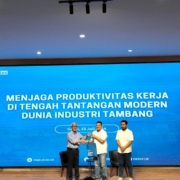
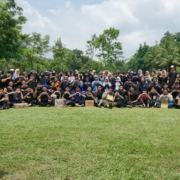
The Industrial Modeling and Simulation Laboratory (DELSIM), Industrial Engineering, Faculty of Industrial Technology (FTI), Islamic University of Indonesia (UII) held Seminar #2 offline on Friday (05/12) with the topic “The Role of System Simulation in Modern Industrial Decision-Making”. A total of 62 participants attended this event. This event aimed to provide insight to students and participants regarding the application of system simulation to solve complex industrial problems and support strategic decision-making in companies.
Demas Rakha Freeporta and Bintang Nairah Yuan served as the Master of Ceremony (MC) and opened the seminar at 08.00 WIB. After the opening, the two MCs led the participants in singing the Indonesian national anthem, Indonesia Raya, and the UII anthem. Daffa Allamsyah delivered a speech as the DELSIM Lab Assistant Coordinator. Next, Didin Dwi Novianto, S.T., M.LSCM., delivered a speech as a representative of UII lecturers. Before entering the material session, the MC introduced Amanda Trixie Alsyaviar as the seminar moderator.
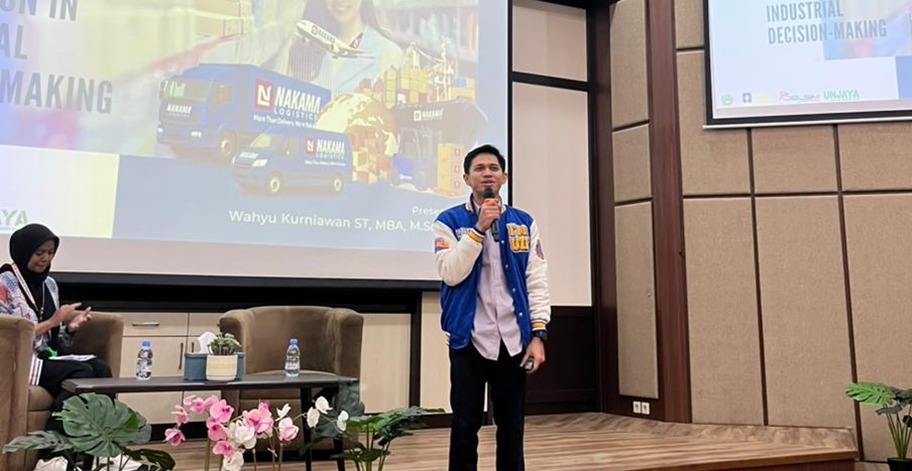
Amanda then introduced the speaker for this seminar, Wahyu Kurniawan, S.T., MBA., M.Sc., CISCP. Wahyu actively teaches at Jenderal Achmad Yani University in Yogyakarta and has nearly ten years of experience in an industry with a CAGR growth rate of approximately 78.9% between 2016 and 2020. This professional experience has shaped his expertise in logistics and supply chain management, business development, financial analysis, feasibility studies, and business and financial reporting.
When and Why Choose Simulation?
Wahyu opened the presentation by explaining the importance of selecting the right timing for using simulation to solve industrial problems. He emphasized that not all problems require simulation therefore, the chosen method must match the problem’s complexity. In operations research, there are three levels of methods. First, exact methods such as the simplex method address well-structured problems. Second, probabilistic methods or metaheuristics handle problems with moderate complexity. Finally, simulation supports problems with high levels of complexity and uncertainty.
“There is a hierarchy in which a problem can be solved by various approaches. Simulation is used when we are dealing with complex problems,” he said.
Wahyu continued by providing several criteria for recognizing complex problems, such as high data variability and the number of variables in a system. To clarify this point, Wahyu presented a project he is currently conducting. The project involved transporting sludge waste from 451 oil drilling wells with unstable production levels. Through this example, Wahyu showed the fluctuating data variation and the large number of transportation points prevented effective mathematical modeling, so researchers used simulation to solve the problem.
Interactive Discussion Session
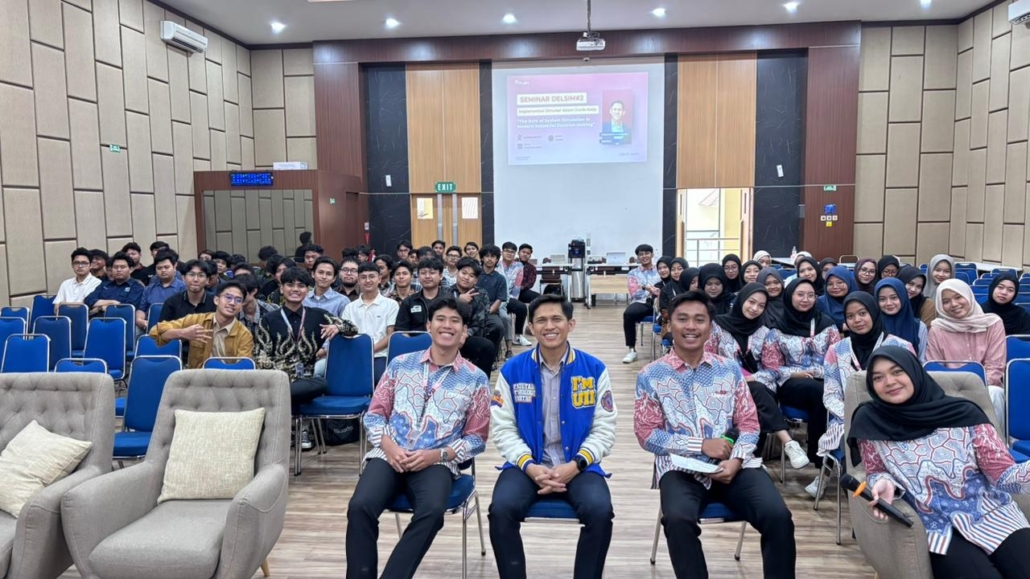
During the discussion session, participants actively discussed how industries apply simulation and how transportation cost uncertainty influences decision making. They raised issues about production scheduling instability in the beverage industry and compared alternative solutions. Participants also asked researchers to clarify model validation in job shop studies and to explain methods for identifying root causes, setting priorities, and choosing effective problem-solving strategies.
To clarify this, Wahyu explained that shipping line simulation offers a flexible approach to evaluating transportation uncertainty across various operational scenarios. Furthermore, he addressed job shop research by describing makespan as an optimization parameter in metaheuristics. In addition, Wahyu emphasized the need to retest optimization results through simulation to ensure real world effectiveness. Finally, he highlighted the importance of identifying root causes before determining improvement alternatives.
In conclusion, this discussion session emphasized the role of simulation beyond mere technical analysis. Simulation helps to understand the overall behavior of systems in complex and uncertain conditions. Participants showed great enthusiasm during the discussion session. These insights encouraged participants to continue developing their analytical skills and utilizing simulation in more accurate and efficient decision making.
Nisrina Nur Masrefa