Tag Archive for: industrial engineering

Becoming an outstanding student is not something that can be achieved overnight. The experiences, achievements, and personal development built throughout university can become important foundations for taking part in the 2026 UII PILMAPRES. This was part of the journey of Ahmad Arro’uf Sulfuadi, an Industrial Engineering student from the Faculty of Industrial Technology, Universitas Islam Indonesia (UII), who successfully won third place in UII PILMAPRES 2026.

Held in March 2026, UII PILMAPRES is part of UII’s selection process for the national Outstanding Student Selection program. The selection assesses students based on several aspects, including 10 Outstanding Achievements, Creative Ideas, and English language skills.

Building Achievements from the Beginning of College

For Ahmad, preparing for UII PILMAPRES was not something that could be accomplished in a short period. The achievements he presented in the selection had been accumulated since his first year as a student at UII.

From his various experiences, Ahmad selected his 10 best achievements across different categories, ranging from competitions and publications to recognition, organizational activities, and professional experiences.

Meanwhile, preparation for the Creative Ideas (GK) component began in early January 2026. The idea was developed through reflection on Ahmad’s journey and experiences as a student since 2023.

“Preparing for PILMAPRES can’t be done overnight. I’ve been collecting Outstanding Achievements since I was a freshman at UII.”

The PILMAPRES selection process began at the faculty level. After the faculty selection, the selected candidates continued to the university-level selection, where they competed for the top three positions.

Facing Challenges with Limited Time

One of the challenges Ahmad faced was the administrative process, which had to be completed within three days. After waiting for more than two months for the results of the faculty selection, Ahmad communicated directly with the Deputy Dean of KKA FTI, Dr. Arif Hidayat, S.T., M.T.

Through this process, Ahmad was entrusted with representing the Faculty of Industrial Technology (FTI) at the university-level PILMAPRES selection. With a short deadline, he had to prepare various selection requirements within a limited period.

Ahmad also had to schedule the CILACS CEPT test with little time for preparation while completing a five-minute English video challenge.

During the preparation process, Ahmad received support from various parties. Dr. Arif Hidayat, S.T., M.T. helped him obtain an Intellectual Property Rights (IPR) achievement as an additional accomplishment, while Dr. Dwi Adi Purnama, S.T., his Creative Ideas supervisor, provided input to make the idea more comprehensive and realistic for implementation.

Support also came from Ahmad’s friends, who helped him prepare various requirements and necessities for the competition.

Journey and Reflection through UII PILMAPRES 2026

The various processes ultimately led Ahmad to win third place in UII PILMAPRES 2026. However, for him, this achievement represents more than simply receiving an award.

Participating in PILMAPRES gave Ahmad an opportunity to evaluate himself and reflect on the experiences he had gained throughout his university journey. For him, being an outstanding student also comes with a moral responsibility to continue demonstrating positive values without losing his identity.

“I view it as a time to reflect on my journey. Furthermore, this achievement also serves as a moral responsibility for me to act as an outstanding student without losing my identity.”

Ahmad hopes that more students from the Science and Technology (SAINTEK) field, particularly those from the Faculty of Industrial Technology (FTI), will have the confidence to participate in PILMAPRES. He believes that outstanding students do not always have to come from the Social Sciences and Humanities (SOSHUM) field.

“Outstanding students don’t always have to come from the Social Sciences and Humanities fields. I believe FTI, as part of SAINTEK, has great potential to excel in the PILMAPRES event.”

Ahead of UII PILMAPRES 2027, Ahmad also encouraged FTI students who are interested in participating to start preparing early and not hesitate to discuss their plans with others.

The journey to UII PILMAPRES 2026 demonstrates that achievements are not built overnight. The accomplishments, experiences, ideas, and personal development accumulated throughout university can become valuable foundations for embracing opportunities and facing challenges at the university level.


Kaila Bilbina M.S

When you hear the word ergonomics, you might think about comfortable sitting positions, proper desk height, or how to lift objects to avoid injury. However, ergonomics encompasses much more than that. The DSKE Lab is a learning space that examines how humans interact with their work, tools, technology, and environment to ensure that systems operate more safely, comfortably, effectively, and efficiently.

The DSKE Lab, or Work System Design and Ergonomics Laboratory, is located in the Industrial Engineering, Faculty of Industrial Technology, Islamic University of Indonesia (UII). This laboratory serves as a learning and research space where students can understand the relationship between humans and work systems while developing solutions oriented toward human needs.

Learning at the UII DSKE Lab: From Understanding the Human Body to Designing Work Systems

Anatomi dan Fisiologi

Before designing a work system, students must first understand who will use the system humans. Therefore, learning begins with an understanding of the human body, its capabilities, and its limitations.

Through Anatomy and Physiology, students learn about various systems in the human body, including the cardiovascular, respiratory, musculoskeletal, and nervous systems, as well as physiology and metabolism. Learning also covers the five senses, how humans receive and process information, and the concept of human error. This understanding forms the basis for examining how physical conditions and human capabilities can influence work activities.

After understanding human characteristics, students then study ergonomics. At this stage, learning begins to focus on the relationship between humans, their work, and their environment. Topics include anthropometry, human physiology, physical and mental workload, the physical work environment, prevention of musculoskeletal disorders, and cognitive ergonomics. Students also study displays and controls, reaction speed, manual material handling, and an introduction to macro ergonomics.

This understanding is then applied to the Measurement and Design of Work Systems. Students learn how work systems can be analyzed and designed based on data. The material includes work measurement methods such as time study and work sampling, motion economy, work maps, indirect labor measurement, tool design, physical work environment design, and usability.

At this stage, students do not stop at the analysis process. They also learn to implement and evaluate work system designs. One way to apply this knowledge is through a major assignment, which can then be developed and presented at events such as an expo.

Meanwhile, the Occupational Safety and Health (OHS) aspect complements students’ understanding of how work systems can operate safely. Students learn basic OHS concepts, potential hazards, risks, causes of workplace accidents, and various hazard identification and analysis methods, such as JSA (Job Safety Analysis), HIRARC (Hazard Identification, Risk Assessment, and Risk Control), HAZOP (Hazard and Operability Study), FTA (Fault Tree Analysis), and FMEA (Failure Mode and Effects Analysis). Learning also covers risk assessment, hazard control, OHS management systems, accident investigation, and the importance of communication and safety culture.

Thus, learning in the DSKE field is not limited to a single aspect. Students learn to understand people, analyze jobs, design systems, and ensure the safety of those systems for their users.

Learning Through Practicals, Simulations, and Technology

Driving Simulator

One of the things that makes learning in the laboratory engaging is the opportunity to connect theory with hands-on experience. The DSKE Lab has various facilities to support student learning, practical work, and research activities.

In addition to classrooms and assistant rooms, there is a tool room that can be used for studying and developing various academic activities. The DSKE Lab also has a Driving Simulator that can be used to simulate driving activities.

There is also a climate room that allows students to study the physical work environment in a controlled setting. Various conditions, such as lighting, temperature, noise, and vibration, can be incorporated into learning activities and experiments. This facility allows students to more clearly understand how environmental conditions affect humans during activities.

Alat Lab DSKE

Technology is also an important part of learning and research activities. The DSKE Lab has various devices, including an eye tracker, Galvanic Skin Response (GSR), Muse Headband EEG, 5-in-1 environmental meter, spirometer, and Oculus virtual reality equipment.

These tools help students collect data from various aspects of human behavior and environmental conditions. For example, an eye tracker can be used to study visual attention, while devices such as GSR and EEG can support research related to physiological responses and human activities.

The use of these technologies demonstrates that ergonomics is not limited to direct observation. Technological advancements allow for increasingly diverse approaches to measuring and researching human behavior and responses.

From the Laboratory to Solving Real-Life Problems

DSKE Lab

The knowledge learned in the DSKE Lab is closely related to everyday life, from uncomfortable chairs and fatigue caused by repetitive work to difficulties understanding applications and noisy, hot, or poorly lit work environments. Through an ergonomics perspective, students learn to identify problems, understand their causes, take measurements, and design solutions that meet human needs.

This is crucial for Industrial Engineering students because a good system must not only be effective and efficient but also consider human capabilities, limitations, safety, and comfort. This becomes especially relevant in the era of Society 5.0, when technology is increasingly integrated into everyday life and needs to be designed to work in harmony with humans.

This experience was also felt directly by one of the DSKE Lab alumni, Devoni, who is now working as a QHSE professional at PT Samudera Indonesia Tbk.

“As an alumnus now working as a QHSE, I’ve experienced firsthand how my experience at the DSKE Lab has significantly contributed to my career. The learning and experience I gained as a laboratory assistant are closely tied to my current position, as the disciplines fall within the same field.”

Through learning and research, the DSKE Lab provides a space for students to understand that humans are a vital part of every system. Ultimately, the goal of ergonomics is to create systems that are not only effective and efficient but also safe, healthy, comfortable, and optimized for humans.


Kaila Bilbina M.S

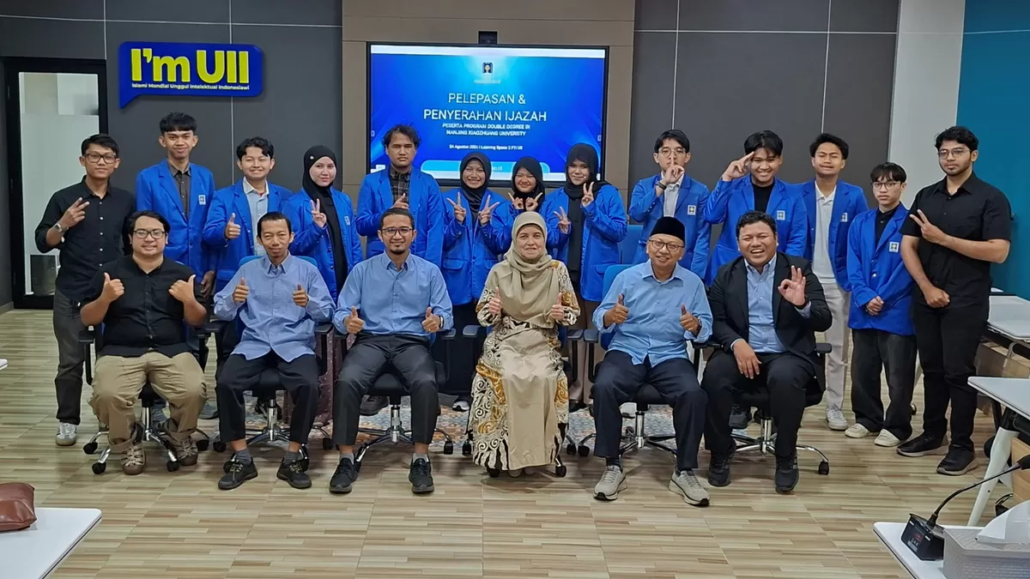
The opportunity to gain international academic experience can open new pathways for students to develop their academic and professional potential. This opportunity has been embraced by six students from the Industrial Engineering Study Program, Faculty of Industrial Technology, Universitas Islam Indonesia (UII), class of 2024: Natasya Dyah Anggraini, Na’ila Nashif Al Hazami, Hafidz Abdurrahman, Iqra Azzahra Ibrahim, Fauzan Zain, and Hana Alyadhia Loso, who successfully passed the 2026 Industrial Engineering Double Degree Program.

The program offers a new opportunity for the 2024 cohort, as it was the first time the Double Degree Program was opened to students from this cohort. As one of the participants, Natasya will study Robotics Engineering at NXU. Although the field differs from her original major, Industrial Engineering and Robotics Engineering are closely connected to the industrial sector, particularly in the development of technology and manufacturing processes. Her studies at NXU will focus more on hard manufacturing and related technological applications.

Starting with Information About the Program

Natasya first learned about the Industrial Engineering x NXU Double Degree Program through the official group for the 2024 cohort, which was managed with the involvement of lecturers. The opportunity immediately caught her attention because she believed that international academic experience could broaden her future career opportunities.

Natasya received information about the program around November 2024, when she was still in her first semester. To participate, she and her classmates had to go through a selection process that considered their English language skills and academic performance.

The selection process presented its own challenges. One of Natasya’s main concerns was her English proficiency, particularly her speaking skills. She felt more confident in writing because of her interest in it, but she rarely had opportunities to practice speaking. In addition, the relatively short preparation period made the decision to register challenging.

“I am quite confident in writing because I happen to like writing. However, I rarely practice my speaking skills. In addition, with the timeline being very short, the decision to join felt quite reckless to me,” said Natasya.

Despite these concerns, Natasya decided to take the opportunity. After being selected for the 2026 Industrial Engineering Double Degree Program, she began maximizing her preparation. Her preparations included improving her English skills through interactive learning applications, attending Mandarin classes, and completing various administrative requirements.

Developing an Interest in Automation and Electrical Engineering

For Natasya, participating in the UII Double Degree Program is not only about experiencing life and education abroad. The program also provides an opportunity to explore fields that have increasingly captured her interest, particularly automation and electrical engineering.

Studying Robotics Engineering at NXU is expected to give Natasya a deeper understanding of manufacturing and technological applications. Through this cross-disciplinary academic experience, she hopes to expand her knowledge beyond the conventional scope of Industrial Engineering.

In addition to her academic preparation, Natasya is also focusing on developing her Mandarin language skills to support her adaptation to a new environment. The cultural differences between Indonesia and China are among the aspects of the experience that she is most looking forward to.

At the same time, adapting to a new environment presents its own challenges. Natasya had never traveled long distances for an extended period before, making cultural adaptation and learning Mandarin two of her main priorities before leaving for China.

Building a Global Perspective for the Future

Through the Industrial Engineering x NXU Double Degree Program, Natasya hopes to develop a stronger global perspective, both academically and professionally. She also hopes that the experience will allow her to build international networks and discover new opportunities for her future career.

For Natasya, studying in an international environment is not simply about pursuing education in another country. It is also an opportunity to learn how to adapt to different environments, develop new skills, and gain exposure to perspectives and academic cultures that differ from those in Indonesia.

She encouraged students from the 2025 cohort who are interested in joining similar programs to start preparing early, particularly by improving their English skills and maintaining strong academic performance.

“If you’re interested in joining, keep practicing your English and make sure you maintain your GPA,” she said.

The participation of Natasya and her fellow students in the 2026 Industrial Engineering Double Degree Program reflects the commitment of UII students to developing themselves and competing in an increasingly global environment. Their cross-disciplinary experience in Robotics Engineering, exposure to Chinese academic culture, and efforts to develop language and communication skills are expected to become valuable parts of their academic and professional journeys.

Participants of the 2026 Industrial Engineering Double Degree Program

ParticipantStudent ID
Hana Alyadhia Loso24522058
Fauzan Zain24522070
Iqra Azzahra Ibrahim24522165
Hafizd Abdurrahman24522190
Natasya Dyah Anggraini24522227
Nai'la Nashif Al Hazami24522228

Kaila Bilbina M.S
Industrial Engineering is a field of engineering with a broad scope of knowledge that adapts to changing times. Unlike other engineering majors that focus on specific products or machines, Industrial Engineering studies systems as a whole. These systems involve people, machines, materials, methods, and information.

This systems approach makes Industrial Engineering known as an engineering major with flexible career prospects. To understand this flexibility, we first need to look at the broad range of knowledge within Industrial Engineering.

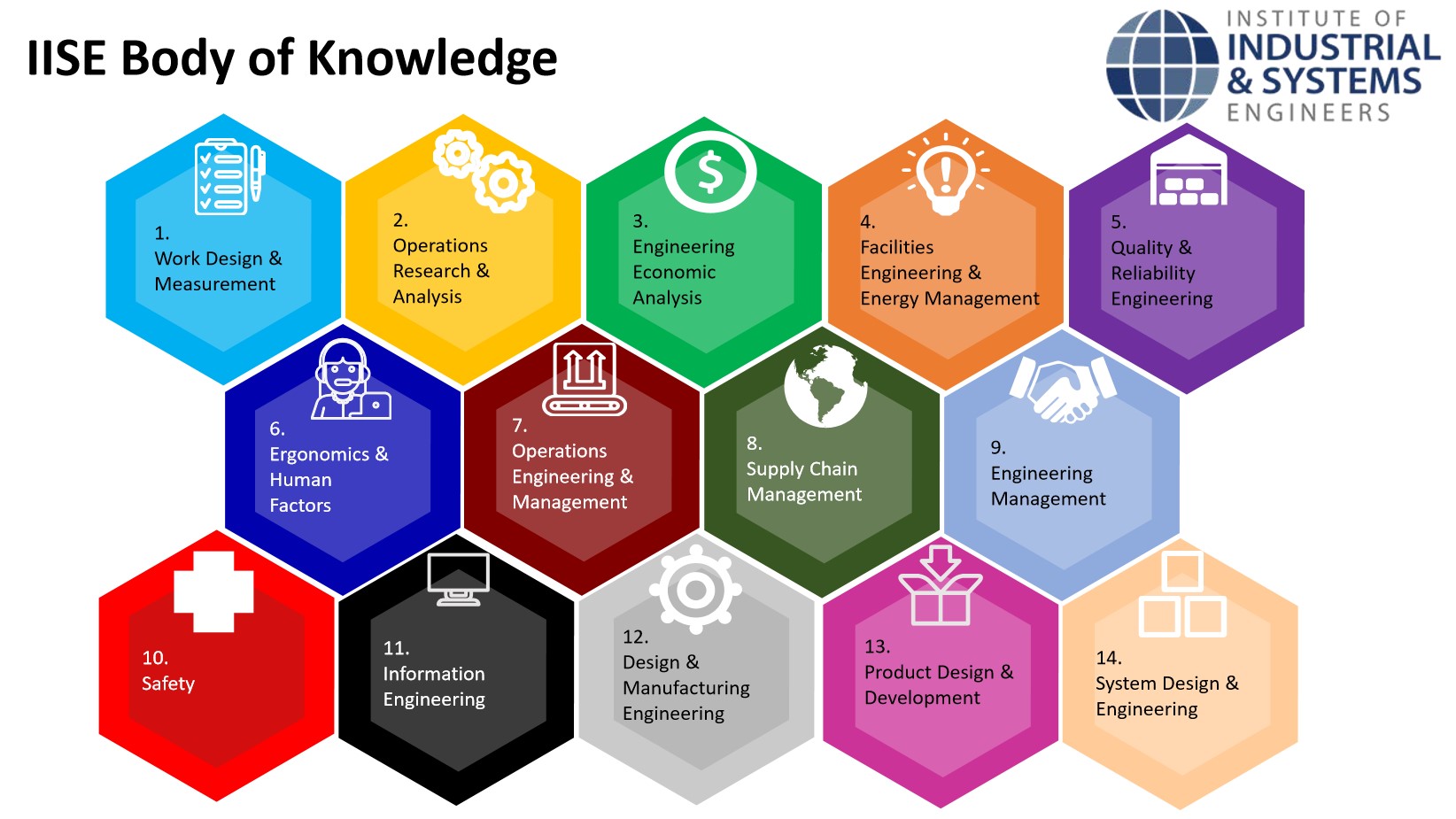
Source: IISE.org

The scope of Industrial Engineering covers various important aspects of industry. Students learn about production planning and control, supply chain management, quality control, ergonomics, occupational safety and health (OSH), as well as work system analysis and design.

Industrial Engineering combines engineering and management knowledge. This combination helps graduates understand technical processes while also managing and optimizing overall industrial systems. This broad range of knowledge creates many career opportunities for Industrial Engineering graduates.

Wide Career Options for Industrial Engineering Graduates

The career flexibility of Industrial Engineering graduates can be seen from the wide range of available job opportunities. Graduates can work in manufacturing, logistics, management consulting, human resources, quality assurance, supply chain, and data analysis.

Analytical skills, problem solving abilities, and process improvement skills also provide an advantage. These skills allow Industrial Engineering graduates to contribute to various sectors, including service and digital industries.

Industrial Engineering UII alumni also experience this career flexibility firsthand. One of them is Zahid Anugrah Muzaffar Rana, who currently works in the maritime and transportation logistics sector. According to him, his Industrial Engineering knowledge has greatly supported his work. This knowledge has developed a systematic way of thinking that helps him understand business processes as a whole.

“Industrial Engineering trains us to think systematically, which helps me analyze the company’s end-to-end business processes, operate ERP systems, and support operational problem solving in the field,” said Zahid.

Zahid’s experience shows that Industrial Engineering graduates can apply their knowledge beyond the manufacturing sector. Supply Chain Management, Enterprise Resource Planning (ERP), and Logistics Management are among the areas that he finds most applicable in his work. These areas are closely connected within an end-to-end business process.

The Role of Industrial Engineering UII in Preparing Graduates

Industrial Engineering UII also supports students in preparing for careers across various fields. The learning process combines theory and practice through laboratory sessions, internships, and industrial system design projects.

Students also use laboratory facilities to support practice based learning. In addition, students become familiar with various supporting software to prepare for the demands of the workplace.

Overall, Industrial Engineering offers broad career flexibility. Graduates can work in manufacturing as well as other fields such as services, logistics, and digital industries.

The learning process at Universitas Islam Indonesia also combines theory and practice. Through this process, students develop analytical and problem solving skills that match workplace needs. These skills help Industrial Engineering graduates adapt and contribute to various industrial sectors.

Albin M Wiryawan

Assalamualaikum warahmatullahi wabarakatuh

Berikut informasi terkait rencana studi Semester Ganjil 2026/2027 bagi mahasiswa Prodi Teknik Industri Program Sarjana Kelas Reguler:

  1. Pada Semester Ganjil 2026/2027, mahasiswa TIDAK perlu melakukan PRA-KEY IN.
  2. Bagi Mahasiswa Angkatan 2026, TIDAK KEY IN karena sudah dipaketkan prodi sesuai kurikulum yang berlaku (Tabel 1).

Tabel 1. Paket MK Semester 1 Angkatan 2026

No.

Kode MK Nama MK

SKS

1

STI101 Pengantar Teknik Industri

2

2

STI102 Biologi

3

3

STI103 Aljabar Linear

3

4

STI104 Kalkulus 1

3

5

STI105 Fisika 1

3

6

STI106 Praktikum Fisika

1

7

STI107 Menggambar Teknik

2

8

STI108 Praktik Menggambar Teknik

1

9

UNI600 Pendidikan Agama Islam

2


  1. Bagi mahasiswa Semester 3 (Angkatan 2025), Semester 5 (Angkatan 2024), dan Semester 7 (Angkatan 2023) melakukan KEY IN secara mandiri, beban SKS yang diizinkan adalah 20–24 SKS sesuai Tabel 2.

Tabel 2. Beban SKS Mahasiswa

IP Semester Sebelumnya Maksimum Beban SKS yang Dapat Diambil
IP ≤ 2,00 20 SKS
2,00 < IP ≤ 2,30 21 SKS
2,30 < IP ≤ 2,60 22 SKS
2,60 < IP ≤ 3,00 23 SKS
IP ≥ 3,00 24 SKS


  1. Bagi mahasiswa Semester 3 (Angkatan 2025), key in dilakukan secara mandiri dengan rincian mata kuliah sebagaimana Tabel 3.

Tabel 3. MK Mahasiswa Semester 3 (Angkatan 2025)

No. Kode MK Nama MK SKS
1 STI301 Riset Operasi 1 3
2 STI302 Statistika 2 3
3 STI303 Kimia 2 2
4 STI304 Sistem Informasi Manajemen 2
5 STI305 Analisis dan Pengendalian Biaya 2
6 STI306 Perilaku Organisasi 2
7 STI307 Material Teknik 2
8 STI308 Ergonomika 2
9 UNI605 Kewirausahaan Syariah 2


Selain itu, mahasiswa Semester 3 (Angkatan 2025) dapat mengambil mata kuliah lain sebagaimana disarankan pada Tabel 4.

Tabel 4. MK Lain yang Bisa Diambil Semester 3 (Angkatan 2025)

No. Kode MK Nama MK SKS
1 STI506 Ekologi Industri 2
2 UNI603 Pendidikan Kewarganegaraan 2


Bagi mahasiswa yang mengambil MK pada Tabel 4 diprioritaskan memilih kelas F untuk mata kuliah pada Tabel 3 dan Tabel 4 guna menghindari bentrok jadwal.


  1. Bagi mahasiswa Semester 5 (Angkatan 2024), rincian mata kuliah semester 5 sebagaimana Tabel 5.

Tabel 5. MK Mahasiswa Semester 5 Angkatan 2024

No. Kode MK Nama MK SKS
1 STI501 Mekanika Teknik 2
2 STI502 Perencanaan dan Pengendalian Produksi 3
3 STI503 Pemodelan Sistem 2
4 STI504 Perancangan dan Pengembangan Produk 2
5 STI505 Analitika Data 2
6 STI506 Ekologi Industri 2
7 STI507 Keselamatan dan Kesehatan Kerja 2
8 STI508 Perancangan Fasilitas 2
9 STI509 Praktik Perancangan Fasilitas 1
10 UNI603 Pendidikan Kewarganegaraan 2


Mahasiswa Semester 5 (Angkatan 2024) dapat mengambil mata kuliah lain sebagaimana disarankan pada Tabel 6.

Tabel 6. MK Lain yang Bisa Diambil Mahasiswa Semester 5 (Angkatan 2024)

No. Kode MK Nama MK SKS
1 STI608 Manajemen Proyek 2
2 UNI604 Pendidikan Pancasila 2
3 STI 9XX Mata Kuliah Pilihan 1 3


Bagi mahasiswa yang mengambil MK pada Tabel 6 diprioritaskan memilih kelas A atau B untuk mata kuliah pada Tabel 5 dan Tabel 6 guna menghindari bentrok jadwal.


  1. Mahasiswa Semester 7 (Angkatan 2023) dapat mengambil mata kuliah yang ditawarkan pada semester ini atau mengulang mata kuliah lain yang dibuka pada Semester Ganjil 2026/2027.

Tabel 7. MK Semester 7 (Angkatan 2023)

No. Kode MK Nama MK SKS
1 UNI604 Pendidikan Pancasila 2
2 STI701 Perancangan Sistem Industri Terpadu 4
3 STI702 Metodologi Penelitian 2
4 STI603 Rekayasa Produktivitas 2
5 STI 9XX Mata Kuliah Pilihan 1 3
6 STI 9XX Mata Kuliah Pilihan 1 3
7 STI 9XX Mata Kuliah Pilihan 1 3


Mata kuliah pilihan yang dibuka pada Semester Ganjil 2026/2027 dapat dilihat pada Tabel 8. Penjelasan isi mata kuliah pilihan dapat dibaca pada Panduan Akademik.

Tabel 8. Mata Kuliah Pilihan Semester Ganjil 2026/2027

No. Kode MK Nama MK SKS
1 STI901 Advanced Automation 3
2 STI910 Industrial Engineering Data Analysis using Excel 3
3 STI918 Human Capital Management 3
4 STI915 Intelligent Optimisation in Supply Chain System 3
5 STI916 Concurrent Engineering 3
6 STI922 Manajemen Resiko 3
7 STI924 Manajemen Aset 3
8 STI942 Cognitive Ergonomic 3
9 STI943 Macro Ergonomy 3
10 STI903 Halal Supply Chain Management 3


  1. Mahasiswa Semester 7 (Angkatan 2023) serta mahasiswa angkatan sebelumnya dapat mengambil mata kuliah lain sebagaimana disarankan pada Tabel 9.

Tabel 9. MK Lain yang Bisa Diambil Semester 7 (Angkatan 2023) serta mahasiswa angkatan sebelumnya

No. Kode MK Nama MK SKS
1 STI801 Tugas Akhir 4
2 STI802 Kerja Praktek 2
3 UNI608 Kuliah Kerja Nyata 2


  1. Mahasiswa yang lolos mengikuti Program Pembelajaran di luar kampus (magang mitra prodi, magang mandiri, pertukaran pelajar, dan lain-lain) wajib mengisi data pada UII MBKM untuk proses key in pada konversi mata kuliah. Harap berkoordinasi dengan Prodi.


Berikut merupakan penawaran MK khusus untuk konversi. Mahasiswa yang akan mengambil konversi magang dapat berkonsultasi dengan DPA dan Prodi:

Tabel 10. MK Khusus untuk Konversi Program Pembelajaran di Luar Kampus

No. Kode MK Nama MK SKS
1 STI946 Topik Khusus Ergonomika 3
2 STI917 Topik Khusus Sistem Produksi dan Supply Chain 3
3 STI936 Topik Khusus Manajemen Industri dan Operasi 3

Keterangan: MK tersebut TIDAK untuk diambil mahasiswa jalur kelulusan regular pada semester ini.

  1. Mahasiswa yang lolos untuk mengikuti Program Fast Track MTI UII, silakan berkoordinasi dengan MTI dan Sekprodi S1 untuk key in MK.
  2. Masa KEY IN dilaksanakan sesuai Kalender Akademik UII. Mahasiswa memastikan sudah klik key-in, bukan hanya memilih icon keranjang. Mata kuliah yang ada di keranjang belum terinput di sistem.
  1. Untuk menghindari bentrok jadwal, mahasiswa disarankan mengambil mata kuliah dengan kode huruf kelas yang sama untuk seluruh mata kuliah yang diambil, misalnya memilih kelas A untuk semua mata kuliah. Ketentuan ini berlaku sepanjang kelas masih tersedia.
  1. Prodi hanya akan membuka kuota suatu kelas jika kelas lain dari MK yang sama sudah seimbang pesertanya.

Demikian informasi yang dapat disampaikan. Mohon dapat dicermati dan dijadikan acuan dalam penyusunan rencana studi. Rencana studi wajib dikonsultasikan terlebih dahulu dengan Dosen Pembimbing Akademik (DPA) agar sesuai dengan ketentuan dan kebutuhan akademik masing-masing mahasiswa. Terimakasih.


Wassalamualaikum warahmatullahi wabarakatuh

Prodi Teknik Industri

Fakultas Teknologi Industri

Universitas Islam Indonesia

Expo Big Project 2026

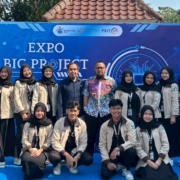
Yogyakarta, July 13-17, 2026 — The Design of Work Systems and Ergonomics Laboratory (DSKE), Industrial Engineering Study Program, Universitas Islam Indonesia (UII), successfully organized the Big Project PPSK 2026 series. The event served as the culmination of the PPSK course, providing students with an opportunity to present and develop the projects they had worked on throughout the semester.

Carrying the theme “Ergonomic Innovation for Human Technology System in the Era of Society 5.0,” the Big Project PPSK 2026 series consisted of class presentations, the Big Project Expo, and the Final Presentation. Beyond being part of the assessment process, the event provided a platform for Industrial Engineering students at UII to develop their communication, collaboration, critical thinking, creativity, and problem solving skills through the application of ergonomics and technology.

Big Project Presentations as the Initial Assessment Stage

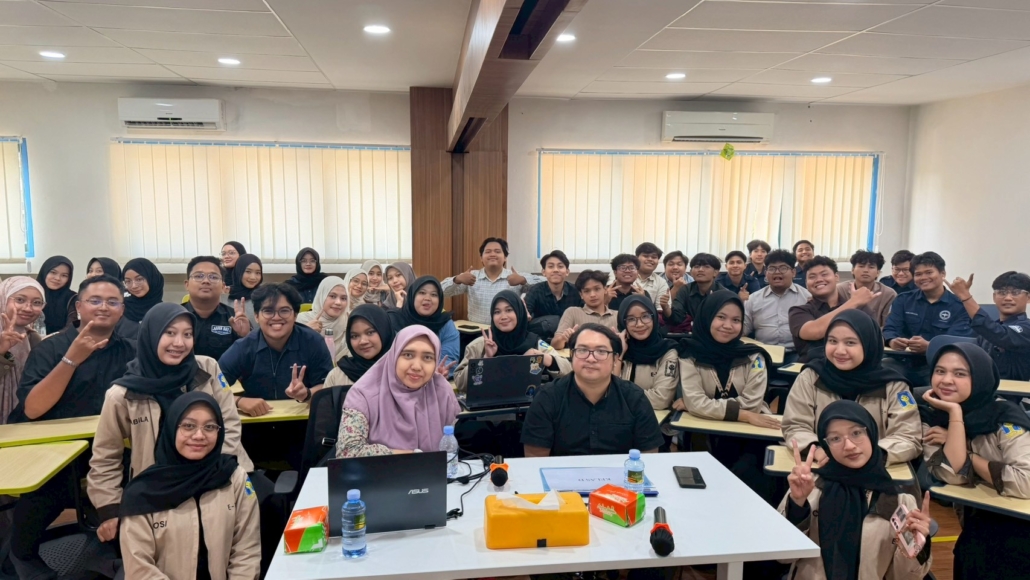
Presentasi BIg Project 2026

The Big Project PPSK 2026 series began with presentations involving 38 teams from all classes, held from July 13-15, 2026. At this stage, each team presented the project they had developed throughout the semester before the panel of faculty judges.

The students presented various aspects of their projects, including the problem background, design process, methods used, and solutions developed. Each project was designed to address issues related to ergonomics and human technology systems in accordance with the theme of Big Project PPSK 2026.

The presentation sessions were followed by questions, feedback, and evaluations from the lecturers. This stage served as part of the learning process as well as the initial assessment before the students proceeded to the expo and final presentation stages.

Big Project Expo Showcases Student Innovations at the FTI Hall

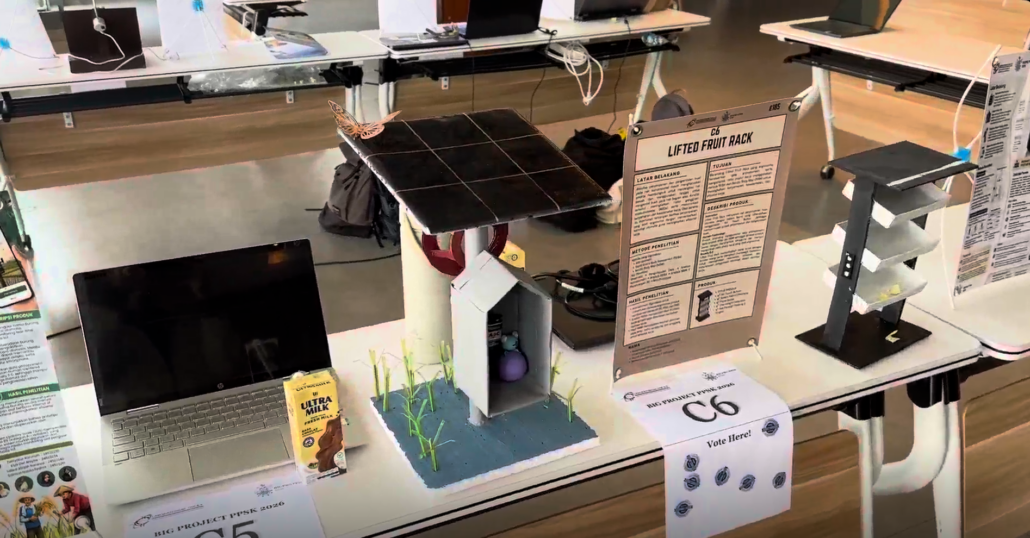
Produk Expo

On the fourth day, July 16, 2026, all teams participated in the Big Project Expo, held at the Faculty of Industrial Technology (FTI) Hall, UII. During the event, students showcased various innovations in the form of products, prototypes, and supporting media developed throughout the learning process.

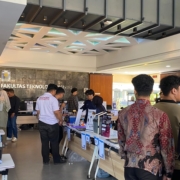
Visitors had the opportunity to explore different exhibition booths and engage directly with the participants to learn about the concepts, benefits, and implementation of the innovations presented. The expo not only served as a platform to showcase project outcomes but also gave students valuable experience in presenting and defending the ideas they had developed.

In addition to providing a space for sharing ideas and experiences, the Big Project Expo was also part of the assessment process. Lecturers evaluated the projects based on several aspects, including innovation, the application of ergonomic principles, presentation quality, and the relevance of the proposed solutions to the needs of the Society 5.0 era.

Final Presentation and Award Ceremony Conclude Big Project PPSK 2026

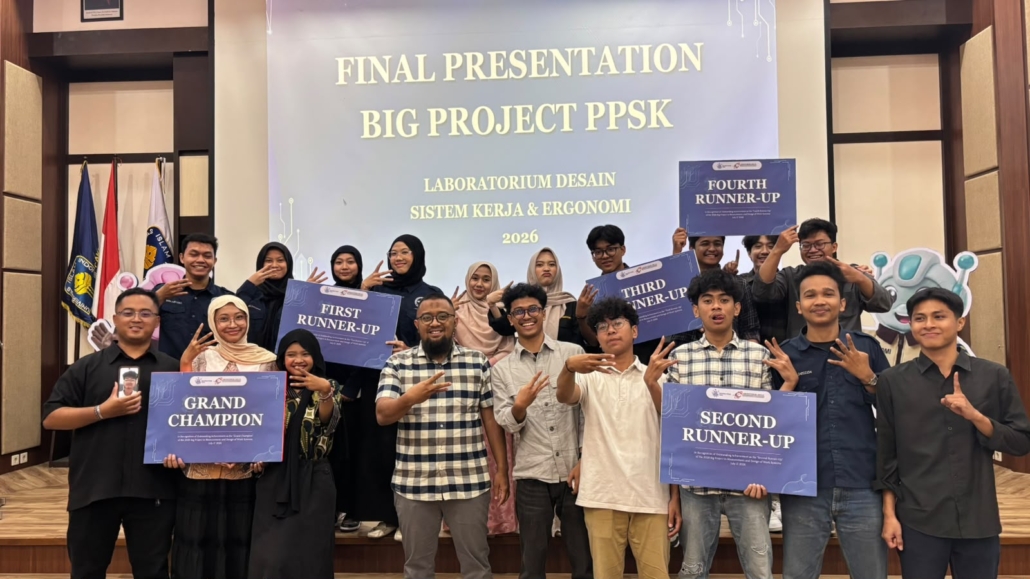
Final Presentation PPSK 2026

The Big Project PPSK 2026 series concluded with the Final Presentation, held on July 17, 2026, at the FTI Auditorium, UII. The event was attended by lecturers, laboratory assistants, and PPSK students as a form of appreciation for the learning process and outcomes achieved throughout the semester.

During the final presentation, the seven best teams, or the Top 7 Finalists, presented their outstanding projects before the panel of judges. Each team explained their innovation, including the problem addressed, design process, benefits, and potential implementation of the proposed solution. Each presentation was followed by a question and answer session as part of the final assessment.

After all finalists had completed their presentations, the event continued with the announcement of the winners and the presentation of awards to the best teams. The awards served as an appreciation of the students’ creativity, innovation, and dedication in developing solutions that integrate ergonomic principles and technology to address challenges in the Society 5.0 era.

Fathan, representing the team that won the Grand Champion title of Big Project PPSK 2026, shared that the event provided a valuable learning experience, particularly in developing innovations and designing solutions based on ergonomic principles.

“Alhamdulillah, Big Project PPSK 2026 has been a valuable learning experience for me to innovate and design solutions to ergonomic challenges in everyday life. This process would not have been possible without the guidance and support of the assistants, particularly E-183 and E-186, who continuously encouraged our team to create, innovate, and keep striving for excellence. I hope that Big Project PPSK 2027 will bring even more exciting ideas and innovations, while providing a memorable and meaningful experience for everyone who takes part.”

The Big Project PPSK 2026 demonstrated how the learning process can serve as a platform for students to transform ideas into innovations that address real-world problems. Through presentations, the expo, and the final presentation, students were not only challenged to develop solutions but also to communicate, defend, and further develop their ideas collaboratively.

With the conclusion of Big Project PPSK 2026, the experiences and innovations produced throughout the program are expected to inspire the implementation of Big Project PPSK 2027 and encourage students to continue developing creative, innovative, and relevant ergonomic solutions in response to technological advancement.

#HumanizeYourself

ACHIEVEMENTKODE KELOMPOKNAMANIMNAMA PRODUK
Grand ChampionD1Fathan Rasikh Abudh24522060Smarthelm 2.0
Hana Alyadhia Loso24522058
Muhammad Ababil Al Murtadlo24522080
Natasya Dyah Anggraini24522227
1st Runner UpA1Willdan Adinata24522014Smart Medicine Box
Aqila Marzaqah Putri Sidharta24522025
Rizqy Noor Hakim24522062
Nasywa Salsabila24522063
Marcella Aulia P.24522221
2nd Runner UpB2Rajab Bullah Anggara Nasution24522254Archipop
Atsaal Zacky Zainurrahman24522128
Naufal Hanif Caesarian24522152
Adhana Khanahara Susanto24522194
Iqra Azzahra Ibrahim24522165
3rd Runner UpIP1Kynan Khairan Ramadhan24522254Devisia
Ednaya Avarielle S.24522128
Septiana Ayu A.24522152
4th Runner UpD6Acmad Chavid Nurdien24522057Smart Gas Cabinet
Akhtar Faiz Gibran24522033
Praba Aryasuta Nugraha24522017
Prabawa Satriyajati Wiyoto24522026
Final PresentationB4Nayla Aninda Kirana24522003Smart Bag
Sakura Holly Oceania Wibowo24522160
Rana Amirah Haidar Amru24522167
Jingga Larissa Praharsini24522209
Final PresentationA3Hanif Ramadhani Hauzan24522099Carevia
Rafeyfa Shaula Asyla24522200
Sekar Hutami Melati Giri24522204
Nisrina Kaysa Ramadhani24522212

Kaila Bilbina M.S
Bertahan di Tengah Arus Modern

Maintaining faith in the modern era can be challenging amid the rapid development of technology, changing lifestyles, and social media. While technological advances offer many benefits, they also present challenges for Muslims to remain committed to Islamic values. In an educational environment such as Industrial Engineering UII, students also encounter these developments as part of their academic and social lives.

Amid a constantly changing world, faith serves as a guide to help people stay on the right path. Keeping up with the times does not mean following every trend. Rather, it means choosing what brings goodness without allowing oneself to drift away from Allah.

Maintaining Faith in the Modern Era

Islam does not prohibit Muslims from embracing modern developments. Muslims can continue to learn, work, socialize, and use technology as long as these activities remain within Islamic values.

Technology can even serve as a means of learning about Islam, spreading goodness, and broadening knowledge. A study titled “Enhancing Student Religiosity Through Islamic Content and Influencer Expertise: Social Media Contribution as Mediator,” involving 180 Muslim university students, found an association between the quality of Islamic content on social media and religious practices. This suggests that the issue is not simply whether technology should be used, but how and for what purpose it is used. Social media can become a platform for learning and spreading Islamic teachings, but it can also become a space for seeking validation and attention.

Challenges to Maintaining Faith in the Modern Era

Modern life makes it increasingly easy for people to see the achievements, lifestyles, and personal lives of others through social media. Without realizing it, this can encourage people to compare themselves with others and seek recognition.

This issue is also discussed in the study “Piety, Social Pressure, and Riya’: Religious Practices of Yogyakarta Urban Muslim Youth in Digital Media,” which examines urban Muslim youth in Yogyakarta. The study shows that digital media can provide a space for young people to express their religious devotion while also creating social pressure through the pursuit of likes and followers.

This is where faith plays an important role as a reminder. Muslims should ask themselves: “Am I doing this truly for Allah, or because I want to be seen and recognized by others?”

The World Is Temporary

Allah reminds humanity about the nature of worldly life in the Qur’an:

اِعْلَمُوْٓا اَنَّمَا الْحَيٰوةُ الدُّنْيَا لَعِبٌ وَّلَهْوٌ وَّزِيْنَةٌ وَّتَفَاخُرٌۢ بَيْنَكُمْ وَتَكَاثُرٌ فِى الْاَمْوَالِ وَالْاَوْلَادِۗ كَمَثَلِ غَيْثٍ اَعْجَبَ الْكُفَّارَ نَبَاتُهٗ ثُمَّ يَهِيْجُ فَتَرٰىهُ مُصْفَرًّا ثُمَّ يَكُوْنُ حُطَامًاۗ وَفِى الْاٰخِرَةِ عَذَابٌ شَدِيْدٌ ەۙ وَّمَغْفِرَةٌ مِّنَ اللّٰهِ وَرِضْوَانٌ ۗوَمَا الْحَيٰوةُ الدُّنْيَآ اِلَّا مَتَاعُ الْغُرُوْرِ

“Know that the life of this world is only play, amusement, adornment, boasting among yourselves, and competition in wealth and children, like rain whose resulting plants please the farmers; then they dry, and you see them turn yellow, and then they become debris. And in the Hereafter there is severe punishment, as well as forgiveness and pleasure from Allah. And the life of this world is nothing but the enjoyment of delusion.” QS. Al-Ḥadīd [57]: 20

This verse reminds us that worldly life is temporary. What may seem extremely important today will eventually pass. Popularity, followers, trends, appearance, wealth, and worldly achievements are not the ultimate measures of human success.

Therefore, worldly possessions may be enjoyed and utilized, but they should not cause the heart to lose sight of its ultimate purpose. Times may change, but faith should remain our guiding principle.

5 Ways to Maintain Faith in the Modern Era

Bertahan di Tengah Arus Modern

How can Muslims remain steadfast amid the currents of modern life? Maintaining faith in the modern era requires consistency in how we worship, interact with others, and use technology.

First, maintain a strong relationship with Allah. The demands of worldly life should not become an excuse to neglect worship. Prayer, supplication, reading the Qur’an, and remembering Allah can help keep the heart grounded and directed toward Him.

Second, choose a good environment. Social relationships have a significant influence on the way people think and behave. Good friends can remind us when we become careless, strengthen us when we feel weak, and encourage us to do good.

Third, use social media wisely. Not every piece of information needs to be consumed, and not every trend needs to be followed. Muslims should learn to choose beneficial content and avoid things that may negatively affect character or disturb inner peace.

Fourth, maintain sincerity. When doing good deeds, the opinions of others should not become the primary motivation. Actions performed for Allah do not always need to receive recognition from other people.

Fifth, continue learning. A changing world requires knowledge. With sufficient religious knowledge and broader understanding, Muslims can better distinguish between progress that brings benefit and changes that may lead them away from Islamic values. Educational environments can also provide opportunities for students to develop knowledge, skills, and values that support them in navigating modern life.

Staying Faithful in a Changing World

Ultimately, maintaining faith in the modern era does not mean rejecting technology or avoiding change. Instead, Muslims should learn to embrace modern developments wisely while continuing to uphold Islamic values and maintain their sense of direction.

Times may change. Technology may continue to develop. The way people communicate may evolve. Yet, faith remains a guiding principle.

Faith does not require us to leave the modern world; it teaches us not to lose ourselves within it.

By treating worldly life as a means to worship Allah and do good, Muslims can benefit from modern developments without allowing themselves to be swept away by them.

The greatest challenge is not living in an increasingly modern world, but remaining a servant of Allah when the world offers countless things that can make us forget Allah.


Kaila Bilbina M.S.

The Industrial Engineering Study Program, Faculty of Industrial Technology (FTI), Islamic University of Indonesia (UII), held the Integrated Industrial System Design (PSIT) EXPO on Friday (July 17). The event took place in the FTI UII Hall from 8:00 a.m. to 11:00 a.m. WIB. The event was opened and hosted by two MCs, Akmal Faiq Fadhillah Hidayat and Bintang Nairah Yuan. As part of the program, welcoming remarks were delivered by Secretary of the Study Program Dr. Sri Indrawati, S.T., M.Eng., and Coordinator of PSIT EXPO 2026 Sayyidah Maulidatul Afraah, S.T., M.T. This year’s PSIT EXPO course focused on the theme of transportation, under the title “Transportation as an Industrial System: Integration of Operations, Infrastructure, and Services.”

From the Learning Process to the Final Project: Lecturer Perspectives on the PSIT EXPO

This PSIT courses is taught by eight Industrial Engineering lecturers from the Faculty of Engineering (FTI) at UII. These lecturer members are Dr. Joko Sulistio, S.T., M.T., M.Sc.; Dr. Harwati, S.T., M.T.; Ratih Dianingtyas, S.T., Ph.D.; Putri Dwi Annisa, S.T., M.Sc.; Wahyudi Sutrisno, S.T., M.M.; Dr. Ir. Yuli Agusti Rochman, S.T., M.Eng., IPU.; Dr. Dwi Adi Purnama, S.T.; and Sayyidah Maulidatul Afraah, S.T., M.T. These eight lecturer members jointly guided the students from the design phase through to the final process, which was presented at the PSIT EXPO.

One of them, Ratih Dianingtyas Kurnia, S.T., Ph.D., shared her insights on the learning process leading up to the PSIT EXPO. She explained that PSIT, also known as Capstone Design, represents the culmination of Industrial Engineering students’ learning journey. The projects exhibited at the event reflect the knowledge and skills they have gained throughout their studies.

“Capstone is the term ‘cap’ means a hat, so this is like the pinnacle. Students have been learning for several semesters, and the results will be evident in this capstone project,” she explained.

Regarding the theme, Ratih explained that the Capstone Design topic changes each year. This year, transportation was chosen due to its importance in daily life and the need for students to address overlooked issues in the sector. In terms of preparation, Ratih acknowledged the challenges of mentoring students with varying abilities and levels of experience. Despite the differences in their final projects, she valued the students efforts to understand and apply the knowledge they had gained. She viewed the PSIT EXPO as an opportunity to assess their understanding of Industrial Engineering while preparing them for their final projects. During the mentoring process, she also enjoyed getting to know each group and was impressed by their enthusiasm in presenting their prototypes. Although challenging, she found the experience exciting and memorable.

Participants Enthusiasm and Appreciation

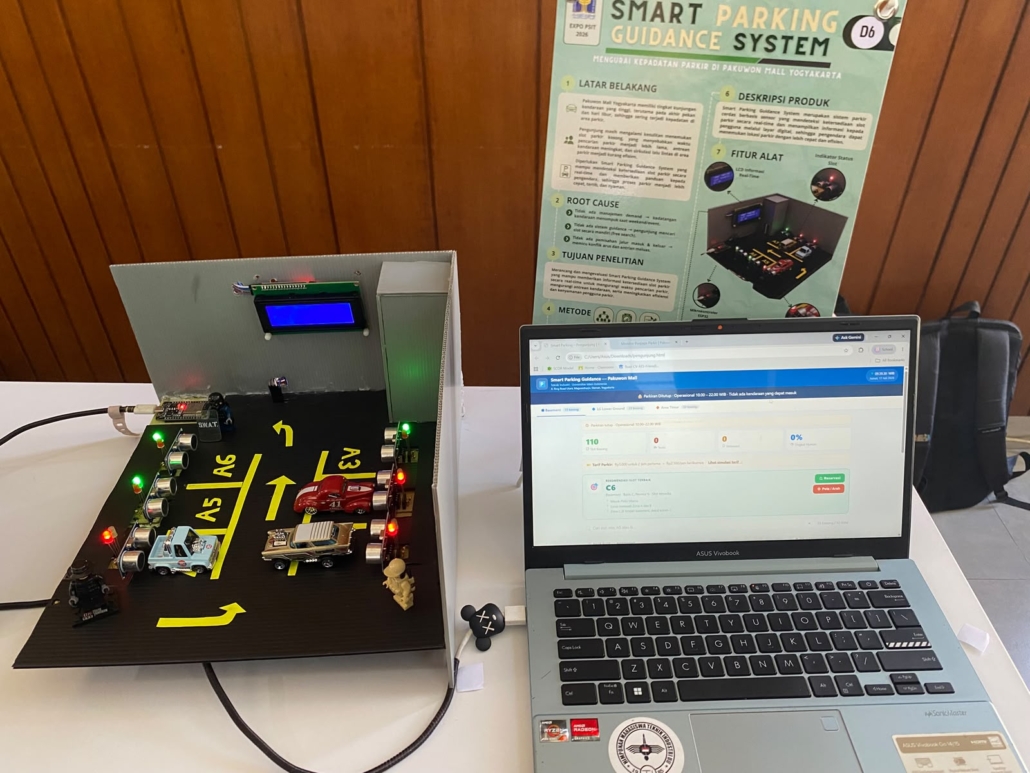
The enthusiasm was also felt by the EXPO PSIT participants themselves. One such participant was Chika Tri Anisa from Group D6. She was excited to see the innovative projects created by her fellow students. She gained new insights into the use of technology in transportation, including parking systems and traffic light control.

His group also present a smart parking system for a shopping center in Yogyakarta that often experiences high visitor traffic. The system recommends nearby parking spots through a dashboard, with red LEDs for occupied spots and green for available ones. So visitors don’t have to drive around looking for a parking spot. At this EXPO, he also observed that the application of Industrial Engineering isn’t limited to manufacturing. It can also be applied in the transportation sector to improve efficiency, safety, and user comfort.

“I’ve come to realize that Industrial Engineering isn’t just about manufacturing, but can also be applied in various fields, including transportation,” said Chika.

Looking ahead, she hopes similar expos will continue to be held on an ongoing basis, involving more industry partners. According to her, industry involvement can provide direct feedback and create opportunities for students projects to reach the real world. Through PSIT EXPO 2026, FTI UII Industrial Engineering students applied their knowledge to develop solutions for transportation challenges. The diverse projects on display also presented the students creativity in developing innovations that can be applied to support the development of transportation systems.

Visits by Experts from Outside the University

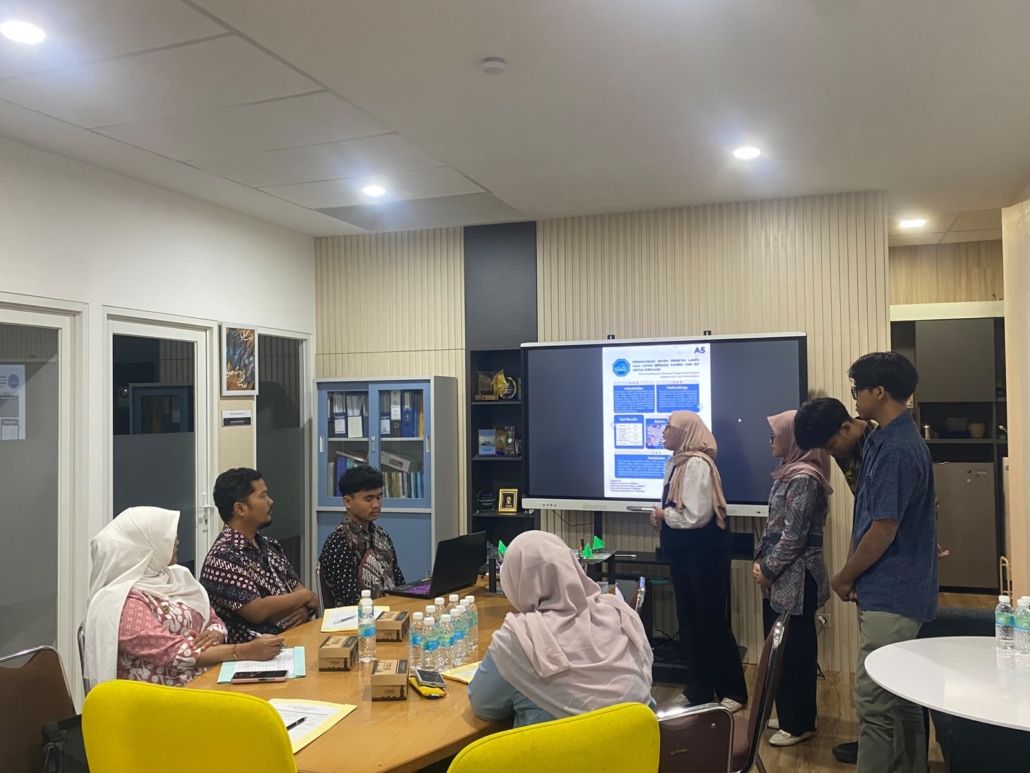
This year’s PSIT EXPO also featured several experts from outside the university to provide evaluations and additional insights for students. This assessment took place in the FTI UII conference room. The experts in attendance included Hanna Pertiwi from PT MRT Indonesia, as well as Khansadinah Nahdah W. and Evak Nurwakhid, A.Md., both of whom are from the Class II Land Transportation Management Agency (BPTD) of the Special Region of Yogyakarta.

Hanna Pertiwi expressed her appreciation for the opportunity provided by FTI UII to be directly involved in the evaluation and to engage in discussions with students. She noted that this experience was very memorable for her, as she was able to discuss and directly try out various innovative projects created by the students. In her view, the ideas presented were not only fresh and marketable but also sufficiently relevant for implementation in the real world.

Hanna hopes these innovations can continue to be developed and expanded, including through cross-program collaboration. She believes that activities like this can broaden students horizons. Additionally, students gain practical experience in developing and applying their ideas. This experience is seen as valuable preparation for entering the workforce. In closing, Hanna urged students to keep creating, learning, and collaborating to make tangible contributions to the workforce and to Indonesia.

“Keep creating, stay eager to learn, and strengthen collaboration for a more advanced Indonesia. We look forward to the contributions of our fellow students in the workforce,” Hanna said.

Best Project Awards

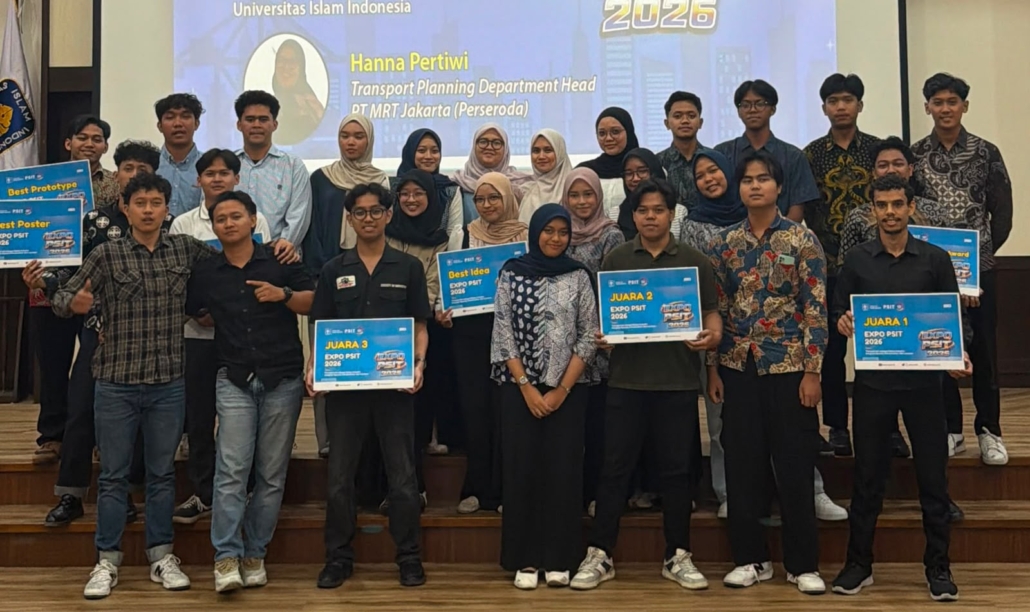
One of the most anticipated events at the PSIT EXPO was the announcement of the top groups. This announcement took place in the FTI UII Auditorium following a public lecture held on the same day. This included the second-place title, which was won this year by Group D4. Khansa Safira Retyaputri, a member of the group, shared her experience of this moment. She admitted she didn’t expect her team to achieve that position, considering that, in her opinion, the innovations from the other groups were just as impressive. Even so, she was grateful for the opportunity that allowed her group to be named second-place winner.

“I didn’t expect it, because honestly, the other groups’ innovations were all awesome too, so alhamdulillah, we were given the chance to be second place,” said Khansa.

Group D4 developed an innovation called the Blind Spot Information System. This innovation is a safety support system that helps truck drivers monitor blind spots around their vehicles. According to Khansa, her team’s success in winning second place was due to the relevance of their solution to real-world problems and the prototype’s ability to demonstrate the performance of the ultrasonic sensor. She hopes that future PSIT EXPO events will continue to grow by showcasing more innovations and opening up broader opportunities for collaboration with the industry.

NoCategoryGroup NameTeam MembersStudent ID Numbers
11st PlaceSIGAPBadr Aldeen Abdulrahman Yahya Ahmed Al-Khazan23522258
21st PlaceSIGAPMuhammad Mahdy Fadhlullah23522282
31st PlaceSIGAPPrabaswara Mahameru Wangid23522037
42nd PlaceD4Muhammad Yusuf Fadilah23522059
52nd PlaceD4Khansa Safira Retyaputri23522149
62nd PlaceD4Muh. Rizky Nabila Akbar23522151
72nd PlaceD4Alan Bayu Kusuma23522266
83rd PlaceC7Rif’at Fayyazhuda Putra23522212
93rd PlaceC7Muhammad Arief Dzikri23522231
103rd PlaceC7Rizky Arya Putra23522152
11Best PrototypeE8Alby Gifari23522232
12Best PrototypeE8Syawarani Gayatri23522122
13Best PrototypeE8Teuku M Rafi Prayogi23522005
14Best PresentationF7Yurcel Listya Artamevia Dewi23522215
15Best PresentationF7Azura Keisha Dzakia Atallah23522275
16Best PresentationF7Ahmad Ali Aji23522288
17Best IdeaA5Nisrina Nur Masrefa23522101
18Best IdeaA5Muhammad Faqih Al-Ikhsan23522111
19Best IdeaA5Rasendria Bhamakerti23522263
20Best IdeaA5Anindya Mayrela Ika Putri23522268
21Best PosterB4Bimi Wirabumi23522020
22Best PosterB4Silvi Andriyani23522194
23Best PosterB4Alim Hidayaturrohman23522296
24People’s Choice AwardF4Elviana Dewi Khusna23522092
25People’s Choice AwardF4Muhammad Revi Yuliansyah23522157
26People’s Choice AwardF4Zifa Aulia Ningrum23522264
27People’s Choice AwardF4Gerren Satrio Hariyudho23522262

Nisrina Nur Masrefa

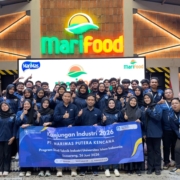
Semarang, June 26, 2026 – The Industrial Engineering Study Program at Universitas Islam Indonesia (UII) organized an industrial visit to PT Marifood, located in the Candi Industrial Estate, Semarang, as part of its commitment to providing students with practical industrial experience. The annual program involved Industrial Engineering students from the Class of 2024 and was designed to strengthen their understanding of concepts taught in the Quality Control and Quality Assurance course.

Accompanied by faculty members, the students explored how manufacturing theories are applied in real industrial settings. The UII industrial visit provided valuable exposure to production systems, quality assurance practices, and modern manufacturing operations, allowing students to connect classroom learning with industry practices.

UII Industrial Engineering Students Explore Manufacturing Processes at PT Marifood

The UII Industrial Visit began with a guided factory tour, where students observed the production process and learned how automated packaging systems improve efficiency and product quality. They gained firsthand knowledge of manufacturing workflows, from raw material processing to finished product packaging, while observing how quality standards are maintained throughout the production line.

Following the factory tour, the participants returned to the main hall and were invited to sample a variety of PT Marifood’s food and beverage products. Several students also had the exclusive opportunity to participate in a tasting session for products that have not yet been released to the public, making the experience even more memorable.

“This has been a completely new and valuable experience throughout my university life. I hope activities like this will continue to be organized in the future,” said Sekar.

The educational visit concluded with a token of appreciation presented by PT Marifood’s management in the form of a framed group photograph, commemorating the collaboration between the company and Universitas Islam Indonesia.

Strengthening Student Bonds at Saloka Theme Park

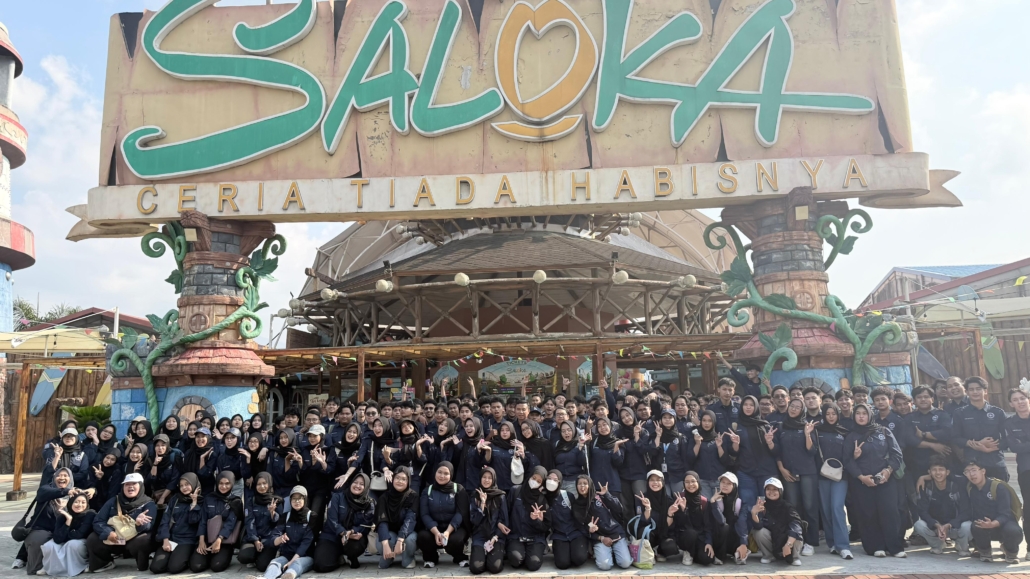
Mahasiswa Teknik Industri di Saloka Theme Park

After completing the academic agenda at PT Marifood, the students continued their journey to Saloka Theme Park in Semarang. The recreational visit provided an opportunity to relax after a full day of industrial learning while strengthening friendships and teamwork among classmates.

As the largest theme park in Central Java, Saloka offered an enjoyable environment where students could create lasting memories before returning to Yogyakarta. The combination of educational and recreational activities highlighted the importance of balancing academic development with student engagement.

“It was so much fun and the perfect opportunity to relax while strengthening our friendship with our classmates. I hope activities like this will continue because they provide unforgettable experiences,” said Salsa.

The industrial visit to PT Marifood and Saloka Theme Park successfully provided Industrial Engineering students from Universitas Islam Indonesia with valuable insights into modern manufacturing practices while fostering stronger relationships among their peers. Through direct exposure to industrial operations and quality management systems, students gained practical knowledge that complements their academic studies and prepares them for future careers in the manufacturing industry.


Kaila Bilbina M.S
For the academic community of Industrial Engineering at Universitas Islam Indonesia, Pancasila is far from a mere theory remembered only during its birth anniversary on June 1st. Instead, this historic moment reminds students to consistently implement Pancasila values in their daily activities. UII has a strong connection to the nation’s foundation. The university’s founding fathers helped formulate Pancasila.

At the Sleman Integrated Campus, the university integrates Islamic and Indonesian values throughout the learning process. Consequently, the campus community preserves this historical momentum not as a repetitive annual routine. Furthermore, Pancasila stands as a moral compass for Industrial Engineering students and the wider Faculty of Industrial Technology (FTI) family in navigating global challenges. In today’s digital era, managing information on social media has become a major challenge. Therefore, digital communication ethics are increasingly important.

Pancasila Values Among Industrial Engineering Students at UII

Students apply Pancasila values through ethical digital communication in cyberspace. Industrial Engineering students understand system design and data governance. As a result, they verify information before sharing news.

Moreover, the Ulil Albab character encourages students to express opinions politely, rationally, and based on facts. They use this filtering process to reduce hate speech, hoaxes, and digital provocations. Consequently, they help prevent social conflicts. This commitment to Pancasila helps curb misinformation. In addition, it also supports social stability and national unity.

How Industrial Engineering Students at UII Promote Unity Through Diversity

Meanwhile, students apply Pancasila values through collaboration and teamwork. This is evident within the learning ecosystem and daily social interactions on campus. Domestic migrant students from various corners of the archipelago and international students blend together seamlessly. They gather without regard for differences in ethnicity, race, or cultural background.

Jihan, an Industrial Engineering student from Riau, shared her perspective on the social dynamics on campus.

“As a student from outside the region, I feel well received in the campus environment. Students do not let regional differences hinder friendship or collaboration, allowing me to adapt comfortably and grow alongside my peers,” she said.

Echoing this sentiment, Yaser, an international student from Yemen in the International Program (IP) of Industrial Engineering at UII, also experienced this inclusive atmosphere firsthand. Both lecturers and fellow students treat him equally without discrimination within the campus environment as a reflection of Pancasila’s tolerance.

“Although I sometimes still find social situations a bit challenging due to language barriers, overall, I really enjoy my learning experience here because everyone is very open and supportive,” Yaser expressed.

Through this mutually supportive campus atmosphere, the faculty has successfully created a comfortable learning environment for everyone. Differences in regional and national origins actually make friendships within FTI UII even more harmonious.

Kaila Bilbina M.S