Becoming an outstanding student is not something that can be achieved overnight. The experiences, achievements, and personal development built throughout university can become important foundations for taking part in the 2026 UII PILMAPRES. This was part of the journey of Ahmad Arro’uf Sulfuadi, an Industrial Engineering student from the Faculty of Industrial Technology, Universitas Islam Indonesia (UII), who successfully won third place in UII PILMAPRES 2026.

Held in March 2026, UII PILMAPRES is part of UII’s selection process for the national Outstanding Student Selection program. The selection assesses students based on several aspects, including 10 Outstanding Achievements, Creative Ideas, and English language skills.

Building Achievements from the Beginning of College

For Ahmad, preparing for UII PILMAPRES was not something that could be accomplished in a short period. The achievements he presented in the selection had been accumulated since his first year as a student at UII.

From his various experiences, Ahmad selected his 10 best achievements across different categories, ranging from competitions and publications to recognition, organizational activities, and professional experiences.

Meanwhile, preparation for the Creative Ideas (GK) component began in early January 2026. The idea was developed through reflection on Ahmad’s journey and experiences as a student since 2023.

“Preparing for PILMAPRES can’t be done overnight. I’ve been collecting Outstanding Achievements since I was a freshman at UII.”

The PILMAPRES selection process began at the faculty level. After the faculty selection, the selected candidates continued to the university-level selection, where they competed for the top three positions.

Facing Challenges with Limited Time

One of the challenges Ahmad faced was the administrative process, which had to be completed within three days. After waiting for more than two months for the results of the faculty selection, Ahmad communicated directly with the Deputy Dean of KKA FTI, Dr. Arif Hidayat, S.T., M.T.

Through this process, Ahmad was entrusted with representing the Faculty of Industrial Technology (FTI) at the university-level PILMAPRES selection. With a short deadline, he had to prepare various selection requirements within a limited period.

Ahmad also had to schedule the CILACS CEPT test with little time for preparation while completing a five-minute English video challenge.

During the preparation process, Ahmad received support from various parties. Dr. Arif Hidayat, S.T., M.T. helped him obtain an Intellectual Property Rights (IPR) achievement as an additional accomplishment, while Dr. Dwi Adi Purnama, S.T., his Creative Ideas supervisor, provided input to make the idea more comprehensive and realistic for implementation.

Support also came from Ahmad’s friends, who helped him prepare various requirements and necessities for the competition.

Journey and Reflection through UII PILMAPRES 2026

The various processes ultimately led Ahmad to win third place in UII PILMAPRES 2026. However, for him, this achievement represents more than simply receiving an award.

Participating in PILMAPRES gave Ahmad an opportunity to evaluate himself and reflect on the experiences he had gained throughout his university journey. For him, being an outstanding student also comes with a moral responsibility to continue demonstrating positive values without losing his identity.

“I view it as a time to reflect on my journey. Furthermore, this achievement also serves as a moral responsibility for me to act as an outstanding student without losing my identity.”

Ahmad hopes that more students from the Science and Technology (SAINTEK) field, particularly those from the Faculty of Industrial Technology (FTI), will have the confidence to participate in PILMAPRES. He believes that outstanding students do not always have to come from the Social Sciences and Humanities (SOSHUM) field.

“Outstanding students don’t always have to come from the Social Sciences and Humanities fields. I believe FTI, as part of SAINTEK, has great potential to excel in the PILMAPRES event.”

Ahead of UII PILMAPRES 2027, Ahmad also encouraged FTI students who are interested in participating to start preparing early and not hesitate to discuss their plans with others.

The journey to UII PILMAPRES 2026 demonstrates that achievements are not built overnight. The accomplishments, experiences, ideas, and personal development accumulated throughout university can become valuable foundations for embracing opportunities and facing challenges at the university level.


Kaila Bilbina M.S

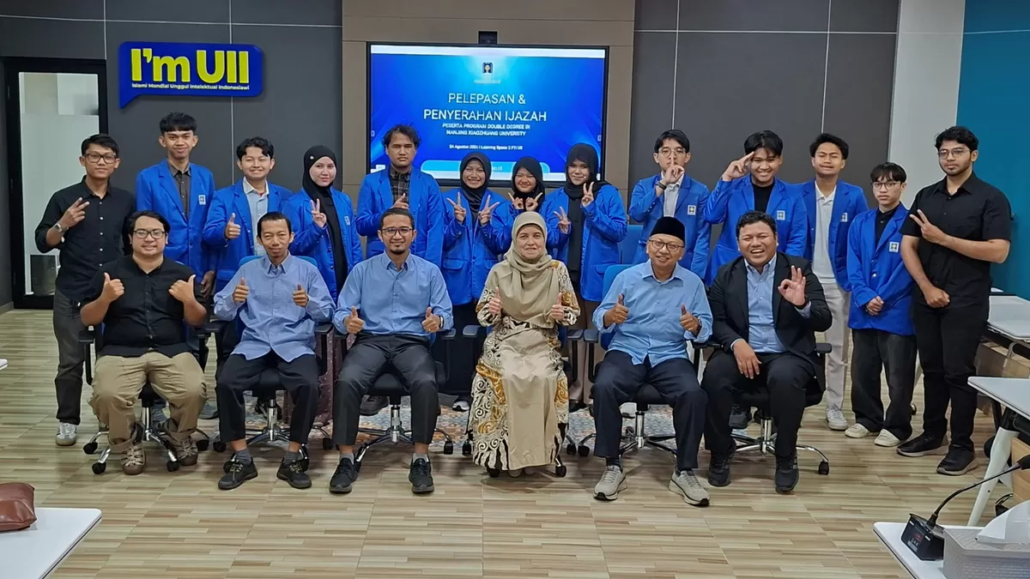
The opportunity to gain international academic experience can open new pathways for students to develop their academic and professional potential. This opportunity has been embraced by six students from the Industrial Engineering Study Program, Faculty of Industrial Technology, Universitas Islam Indonesia (UII), class of 2024: Natasya Dyah Anggraini, Na’ila Nashif Al Hazami, Hafidz Abdurrahman, Iqra Azzahra Ibrahim, Fauzan Zain, and Hana Alyadhia Loso, who successfully passed the 2026 Industrial Engineering Double Degree Program.

The program offers a new opportunity for the 2024 cohort, as it was the first time the Double Degree Program was opened to students from this cohort. As one of the participants, Natasya will study Robotics Engineering at NXU. Although the field differs from her original major, Industrial Engineering and Robotics Engineering are closely connected to the industrial sector, particularly in the development of technology and manufacturing processes. Her studies at NXU will focus more on hard manufacturing and related technological applications.

Starting with Information About the Program

Natasya first learned about the Industrial Engineering x NXU Double Degree Program through the official group for the 2024 cohort, which was managed with the involvement of lecturers. The opportunity immediately caught her attention because she believed that international academic experience could broaden her future career opportunities.

Natasya received information about the program around November 2024, when she was still in her first semester. To participate, she and her classmates had to go through a selection process that considered their English language skills and academic performance.

The selection process presented its own challenges. One of Natasya’s main concerns was her English proficiency, particularly her speaking skills. She felt more confident in writing because of her interest in it, but she rarely had opportunities to practice speaking. In addition, the relatively short preparation period made the decision to register challenging.

“I am quite confident in writing because I happen to like writing. However, I rarely practice my speaking skills. In addition, with the timeline being very short, the decision to join felt quite reckless to me,” said Natasya.

Despite these concerns, Natasya decided to take the opportunity. After being selected for the 2026 Industrial Engineering Double Degree Program, she began maximizing her preparation. Her preparations included improving her English skills through interactive learning applications, attending Mandarin classes, and completing various administrative requirements.

Developing an Interest in Automation and Electrical Engineering

For Natasya, participating in the UII Double Degree Program is not only about experiencing life and education abroad. The program also provides an opportunity to explore fields that have increasingly captured her interest, particularly automation and electrical engineering.

Studying Robotics Engineering at NXU is expected to give Natasya a deeper understanding of manufacturing and technological applications. Through this cross-disciplinary academic experience, she hopes to expand her knowledge beyond the conventional scope of Industrial Engineering.

In addition to her academic preparation, Natasya is also focusing on developing her Mandarin language skills to support her adaptation to a new environment. The cultural differences between Indonesia and China are among the aspects of the experience that she is most looking forward to.

At the same time, adapting to a new environment presents its own challenges. Natasya had never traveled long distances for an extended period before, making cultural adaptation and learning Mandarin two of her main priorities before leaving for China.

Building a Global Perspective for the Future

Through the Industrial Engineering x NXU Double Degree Program, Natasya hopes to develop a stronger global perspective, both academically and professionally. She also hopes that the experience will allow her to build international networks and discover new opportunities for her future career.

For Natasya, studying in an international environment is not simply about pursuing education in another country. It is also an opportunity to learn how to adapt to different environments, develop new skills, and gain exposure to perspectives and academic cultures that differ from those in Indonesia.

She encouraged students from the 2025 cohort who are interested in joining similar programs to start preparing early, particularly by improving their English skills and maintaining strong academic performance.

“If you’re interested in joining, keep practicing your English and make sure you maintain your GPA,” she said.

The participation of Natasya and her fellow students in the 2026 Industrial Engineering Double Degree Program reflects the commitment of UII students to developing themselves and competing in an increasingly global environment. Their cross-disciplinary experience in Robotics Engineering, exposure to Chinese academic culture, and efforts to develop language and communication skills are expected to become valuable parts of their academic and professional journeys.

Participants of the 2026 Industrial Engineering Double Degree Program

ParticipantStudent ID
Hana Alyadhia Loso24522058
Fauzan Zain24522070
Iqra Azzahra Ibrahim24522165
Hafizd Abdurrahman24522190
Natasya Dyah Anggraini24522227
Nai'la Nashif Al Hazami24522228

Kaila Bilbina M.S

For some students, student organizations may be closely associated with activities on campus. Through the Student Organization Capacity Strengthening Program (PPK Ormawa), however, students have the opportunity to engage directly with communities and contribute to developing the potential of rural areas.

The program aims to strengthen students’ capacities while making a tangible contribution to communities through village empowerment initiatives. This year, one of the programs carried out is the Smart Village Program in Ngawis Village, Karangmojo District, Gunungkidul Regency.

Developing Ngawis Village’s Cocoa Potential

Ngawis Village was selected because of its considerable cocoa potential. Through this program, the team seeks to process cocoa into products with greater added and economic value. This initiative is expected to create new opportunities while helping improve the local community’s economy. Through the Smart Village concept, the community is encouraged to develop this potential into various products that can continue to grow even after the program ends.

The program primarily targets village and hamlet heads, farmer groups, Women Farmer Groups (KWT), and youth organizations. These groups are expected to continue and further develop the program in a sustainable manner.

From Theory to Practice

The program began with surveys and the identification of the community’s potential and needs. Following this, the team provided educational activities through four literacy corners: Downstream, Digital, Circular, and Entrepreneur Family. Rather than only receiving theoretical knowledge, community members were also directly involved in product processing and development activities.

As a result, the community has begun processing cocoa into cocoa paste and cocoa powder, while cocoa husks are being utilized to produce cocoa husk tea. Waste materials are also being utilized through the production of mineral blocks to support livestock protein needs. On the digital side, community members have started creating and managing Shopee and TikTok accounts to market their products. This allows cocoa development to focus not only on production, but also on waste utilization and digital marketing.

Learning Through Community Engagement

Through the program, students have gained opportunities to engage directly with the community. It has also allowed them to learn and interact with local residents. Meanwhile, the warm, welcoming, and open nature of the people of Ngawis Village provided the team with valuable experiences throughout their time in the field. As Muhammad Imam Baihaqi, the head of the PPK Ormawa team, stated,

“The success of a program is not only about how we implement it, but also about how we communicate, understand the community’s needs, and work together with them.”

This experience shows that communication and an understanding of community needs are essential parts of implementing a successful empowerment program.

The Program’s Impact on the Community

The people of Ngawis Village have begun processing cocoa into various value-added products, such as cocoa paste, cocoa powder, and cocoa husk tea. In addition, waste utilization through mineral blocks and digital marketing through Shopee and TikTok are part of the effort to expand the benefits and economic potential of the program.

Going forward, the team hopes to further develop the program and create a broader and more sustainable impact on the community. Through PPK Ormawa, students can learn directly from the community while applying the knowledge they have gained. As Haqi shared,

“Don’t hesitate to try and get involved,”

because through this program, students can gain valuable experience while making a tangible contribution to the village.

Albin M Wiryawan

Expo Big Project 2026

Yogyakarta, July 13-17, 2026 — The Design of Work Systems and Ergonomics Laboratory (DSKE), Industrial Engineering Study Program, Universitas Islam Indonesia (UII), successfully organized the Big Project PPSK 2026 series. The event served as the culmination of the PPSK course, providing students with an opportunity to present and develop the projects they had worked on throughout the semester.

Carrying the theme “Ergonomic Innovation for Human Technology System in the Era of Society 5.0,” the Big Project PPSK 2026 series consisted of class presentations, the Big Project Expo, and the Final Presentation. Beyond being part of the assessment process, the event provided a platform for Industrial Engineering students at UII to develop their communication, collaboration, critical thinking, creativity, and problem solving skills through the application of ergonomics and technology.

Big Project Presentations as the Initial Assessment Stage

Presentasi BIg Project 2026

The Big Project PPSK 2026 series began with presentations involving 38 teams from all classes, held from July 13-15, 2026. At this stage, each team presented the project they had developed throughout the semester before the panel of faculty judges.

The students presented various aspects of their projects, including the problem background, design process, methods used, and solutions developed. Each project was designed to address issues related to ergonomics and human technology systems in accordance with the theme of Big Project PPSK 2026.

The presentation sessions were followed by questions, feedback, and evaluations from the lecturers. This stage served as part of the learning process as well as the initial assessment before the students proceeded to the expo and final presentation stages.

Big Project Expo Showcases Student Innovations at the FTI Hall

Produk Expo

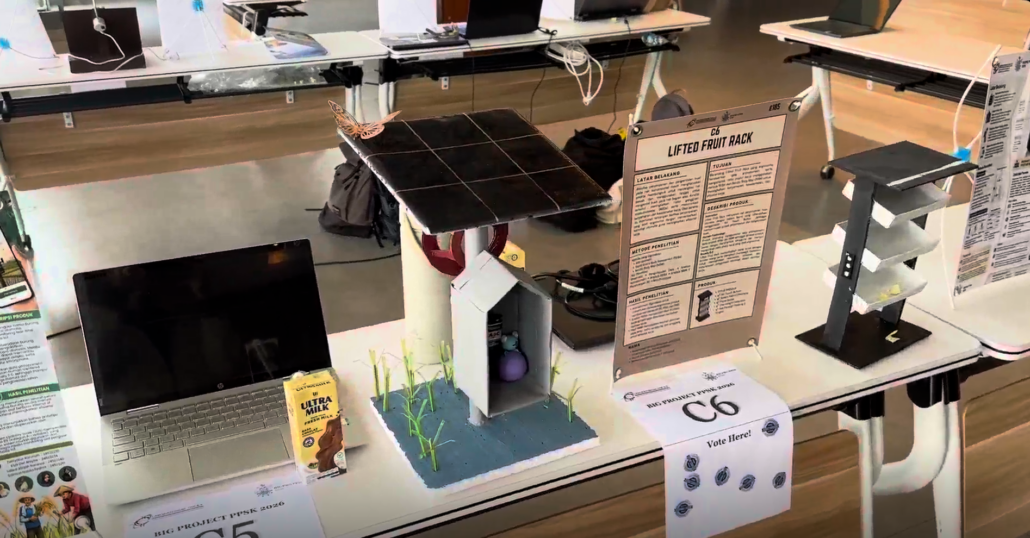
On the fourth day, July 16, 2026, all teams participated in the Big Project Expo, held at the Faculty of Industrial Technology (FTI) Hall, UII. During the event, students showcased various innovations in the form of products, prototypes, and supporting media developed throughout the learning process.

Visitors had the opportunity to explore different exhibition booths and engage directly with the participants to learn about the concepts, benefits, and implementation of the innovations presented. The expo not only served as a platform to showcase project outcomes but also gave students valuable experience in presenting and defending the ideas they had developed.

In addition to providing a space for sharing ideas and experiences, the Big Project Expo was also part of the assessment process. Lecturers evaluated the projects based on several aspects, including innovation, the application of ergonomic principles, presentation quality, and the relevance of the proposed solutions to the needs of the Society 5.0 era.

Final Presentation and Award Ceremony Conclude Big Project PPSK 2026

Final Presentation PPSK 2026

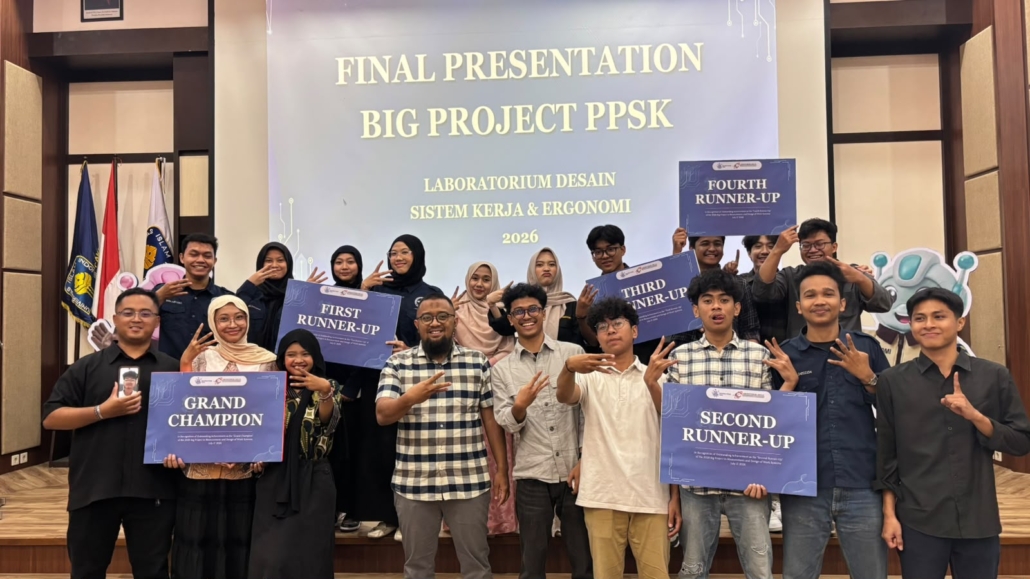
The Big Project PPSK 2026 series concluded with the Final Presentation, held on July 17, 2026, at the FTI Auditorium, UII. The event was attended by lecturers, laboratory assistants, and PPSK students as a form of appreciation for the learning process and outcomes achieved throughout the semester.

During the final presentation, the seven best teams, or the Top 7 Finalists, presented their outstanding projects before the panel of judges. Each team explained their innovation, including the problem addressed, design process, benefits, and potential implementation of the proposed solution. Each presentation was followed by a question and answer session as part of the final assessment.

After all finalists had completed their presentations, the event continued with the announcement of the winners and the presentation of awards to the best teams. The awards served as an appreciation of the students’ creativity, innovation, and dedication in developing solutions that integrate ergonomic principles and technology to address challenges in the Society 5.0 era.

Fathan, representing the team that won the Grand Champion title of Big Project PPSK 2026, shared that the event provided a valuable learning experience, particularly in developing innovations and designing solutions based on ergonomic principles.

“Alhamdulillah, Big Project PPSK 2026 has been a valuable learning experience for me to innovate and design solutions to ergonomic challenges in everyday life. This process would not have been possible without the guidance and support of the assistants, particularly E-183 and E-186, who continuously encouraged our team to create, innovate, and keep striving for excellence. I hope that Big Project PPSK 2027 will bring even more exciting ideas and innovations, while providing a memorable and meaningful experience for everyone who takes part.”

The Big Project PPSK 2026 demonstrated how the learning process can serve as a platform for students to transform ideas into innovations that address real-world problems. Through presentations, the expo, and the final presentation, students were not only challenged to develop solutions but also to communicate, defend, and further develop their ideas collaboratively.

With the conclusion of Big Project PPSK 2026, the experiences and innovations produced throughout the program are expected to inspire the implementation of Big Project PPSK 2027 and encourage students to continue developing creative, innovative, and relevant ergonomic solutions in response to technological advancement.

#HumanizeYourself

ACHIEVEMENTKODE KELOMPOKNAMANIMNAMA PRODUK
Grand ChampionD1Fathan Rasikh Abudh24522060Smarthelm 2.0
Hana Alyadhia Loso24522058
Muhammad Ababil Al Murtadlo24522080
Natasya Dyah Anggraini24522227
1st Runner UpA1Willdan Adinata24522014Smart Medicine Box
Aqila Marzaqah Putri Sidharta24522025
Rizqy Noor Hakim24522062
Nasywa Salsabila24522063
Marcella Aulia P.24522221
2nd Runner UpB2Rajab Bullah Anggara Nasution24522254Archipop
Atsaal Zacky Zainurrahman24522128
Naufal Hanif Caesarian24522152
Adhana Khanahara Susanto24522194
Iqra Azzahra Ibrahim24522165
3rd Runner UpIP1Kynan Khairan Ramadhan24522254Devisia
Ednaya Avarielle S.24522128
Septiana Ayu A.24522152
4th Runner UpD6Acmad Chavid Nurdien24522057Smart Gas Cabinet
Akhtar Faiz Gibran24522033
Praba Aryasuta Nugraha24522017
Prabawa Satriyajati Wiyoto24522026
Final PresentationB4Nayla Aninda Kirana24522003Smart Bag
Sakura Holly Oceania Wibowo24522160
Rana Amirah Haidar Amru24522167
Jingga Larissa Praharsini24522209
Final PresentationA3Hanif Ramadhani Hauzan24522099Carevia
Rafeyfa Shaula Asyla24522200
Sekar Hutami Melati Giri24522204
Nisrina Kaysa Ramadhani24522212

Kaila Bilbina M.S

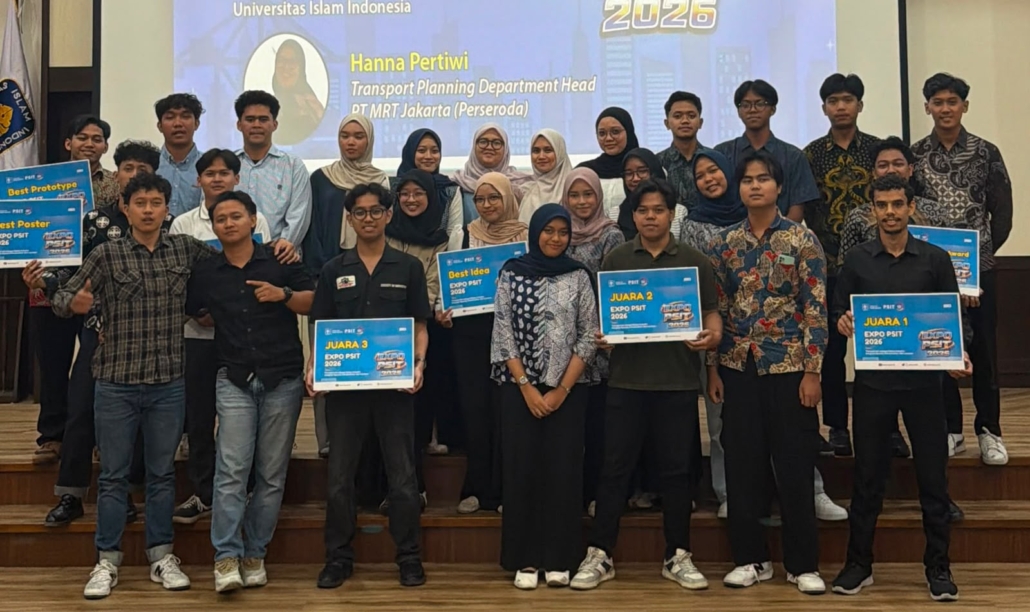
The Industrial Engineering Study Program, Faculty of Industrial Technology (FTI), Islamic University of Indonesia (UII), held the Integrated Industrial System Design (PSIT) EXPO on Friday (July 17). The event took place in the FTI UII Hall from 8:00 a.m. to 11:00 a.m. WIB. The event was opened and hosted by two MCs, Akmal Faiq Fadhillah Hidayat and Bintang Nairah Yuan. As part of the program, welcoming remarks were delivered by Secretary of the Study Program Dr. Sri Indrawati, S.T., M.Eng., and Coordinator of PSIT EXPO 2026 Sayyidah Maulidatul Afraah, S.T., M.T. This year’s PSIT EXPO course focused on the theme of transportation, under the title “Transportation as an Industrial System: Integration of Operations, Infrastructure, and Services.”

From the Learning Process to the Final Project: Lecturer Perspectives on the PSIT EXPO

This PSIT courses is taught by eight Industrial Engineering lecturers from the Faculty of Engineering (FTI) at UII. These lecturer members are Dr. Joko Sulistio, S.T., M.T., M.Sc.; Dr. Harwati, S.T., M.T.; Ratih Dianingtyas, S.T., Ph.D.; Putri Dwi Annisa, S.T., M.Sc.; Wahyudi Sutrisno, S.T., M.M.; Dr. Ir. Yuli Agusti Rochman, S.T., M.Eng., IPU.; Dr. Dwi Adi Purnama, S.T.; and Sayyidah Maulidatul Afraah, S.T., M.T. These eight lecturer members jointly guided the students from the design phase through to the final process, which was presented at the PSIT EXPO.

One of them, Ratih Dianingtyas Kurnia, S.T., Ph.D., shared her insights on the learning process leading up to the PSIT EXPO. She explained that PSIT, also known as Capstone Design, represents the culmination of Industrial Engineering students’ learning journey. The projects exhibited at the event reflect the knowledge and skills they have gained throughout their studies.

“Capstone is the term ‘cap’ means a hat, so this is like the pinnacle. Students have been learning for several semesters, and the results will be evident in this capstone project,” she explained.

Regarding the theme, Ratih explained that the Capstone Design topic changes each year. This year, transportation was chosen due to its importance in daily life and the need for students to address overlooked issues in the sector. In terms of preparation, Ratih acknowledged the challenges of mentoring students with varying abilities and levels of experience. Despite the differences in their final projects, she valued the students efforts to understand and apply the knowledge they had gained. She viewed the PSIT EXPO as an opportunity to assess their understanding of Industrial Engineering while preparing them for their final projects. During the mentoring process, she also enjoyed getting to know each group and was impressed by their enthusiasm in presenting their prototypes. Although challenging, she found the experience exciting and memorable.

Participants Enthusiasm and Appreciation

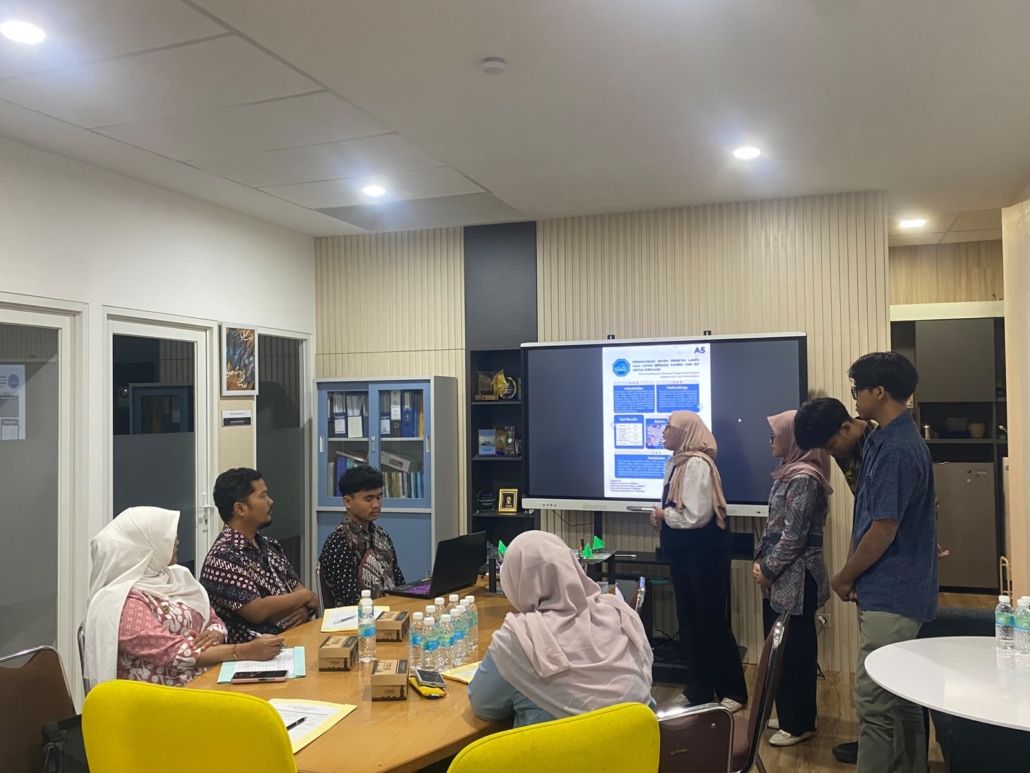
The enthusiasm was also felt by the EXPO PSIT participants themselves. One such participant was Chika Tri Anisa from Group D6. She was excited to see the innovative projects created by her fellow students. She gained new insights into the use of technology in transportation, including parking systems and traffic light control.

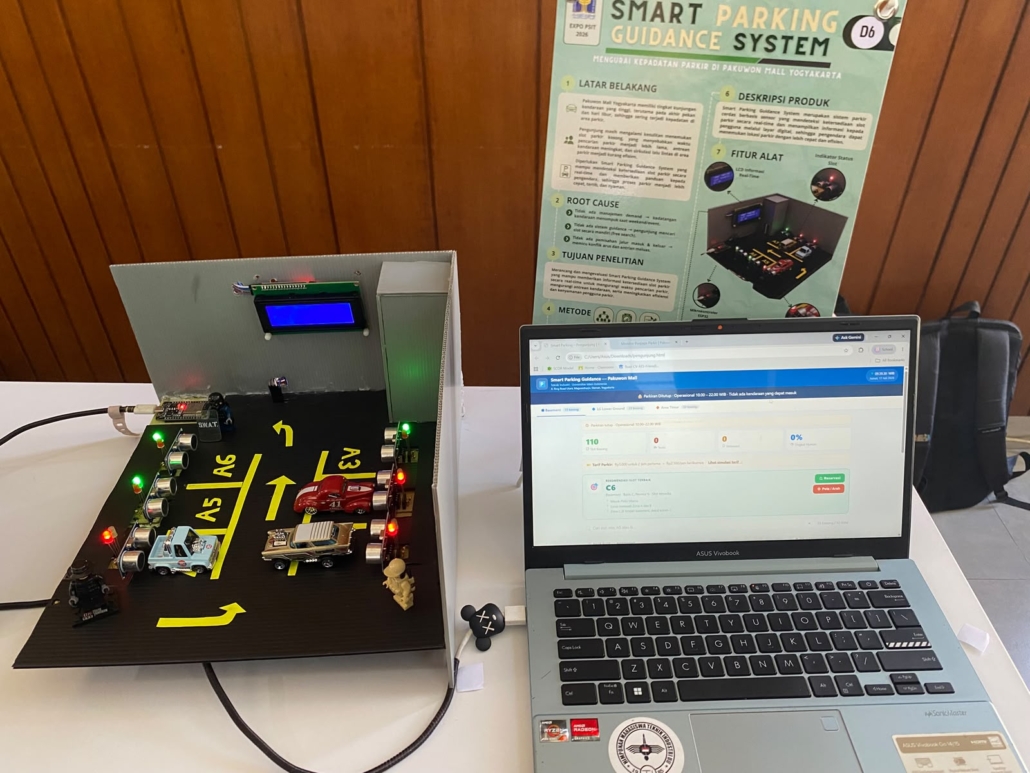
His group also present a smart parking system for a shopping center in Yogyakarta that often experiences high visitor traffic. The system recommends nearby parking spots through a dashboard, with red LEDs for occupied spots and green for available ones. So visitors don’t have to drive around looking for a parking spot. At this EXPO, he also observed that the application of Industrial Engineering isn’t limited to manufacturing. It can also be applied in the transportation sector to improve efficiency, safety, and user comfort.

“I’ve come to realize that Industrial Engineering isn’t just about manufacturing, but can also be applied in various fields, including transportation,” said Chika.

Looking ahead, she hopes similar expos will continue to be held on an ongoing basis, involving more industry partners. According to her, industry involvement can provide direct feedback and create opportunities for students projects to reach the real world. Through PSIT EXPO 2026, FTI UII Industrial Engineering students applied their knowledge to develop solutions for transportation challenges. The diverse projects on display also presented the students creativity in developing innovations that can be applied to support the development of transportation systems.

Visits by Experts from Outside the University

This year’s PSIT EXPO also featured several experts from outside the university to provide evaluations and additional insights for students. This assessment took place in the FTI UII conference room. The experts in attendance included Hanna Pertiwi from PT MRT Indonesia, as well as Khansadinah Nahdah W. and Evak Nurwakhid, A.Md., both of whom are from the Class II Land Transportation Management Agency (BPTD) of the Special Region of Yogyakarta.

Hanna Pertiwi expressed her appreciation for the opportunity provided by FTI UII to be directly involved in the evaluation and to engage in discussions with students. She noted that this experience was very memorable for her, as she was able to discuss and directly try out various innovative projects created by the students. In her view, the ideas presented were not only fresh and marketable but also sufficiently relevant for implementation in the real world.

Hanna hopes these innovations can continue to be developed and expanded, including through cross-program collaboration. She believes that activities like this can broaden students horizons. Additionally, students gain practical experience in developing and applying their ideas. This experience is seen as valuable preparation for entering the workforce. In closing, Hanna urged students to keep creating, learning, and collaborating to make tangible contributions to the workforce and to Indonesia.

“Keep creating, stay eager to learn, and strengthen collaboration for a more advanced Indonesia. We look forward to the contributions of our fellow students in the workforce,” Hanna said.

Best Project Awards

One of the most anticipated events at the PSIT EXPO was the announcement of the top groups. This announcement took place in the FTI UII Auditorium following a public lecture held on the same day. This included the second-place title, which was won this year by Group D4. Khansa Safira Retyaputri, a member of the group, shared her experience of this moment. She admitted she didn’t expect her team to achieve that position, considering that, in her opinion, the innovations from the other groups were just as impressive. Even so, she was grateful for the opportunity that allowed her group to be named second-place winner.

“I didn’t expect it, because honestly, the other groups’ innovations were all awesome too, so alhamdulillah, we were given the chance to be second place,” said Khansa.

Group D4 developed an innovation called the Blind Spot Information System. This innovation is a safety support system that helps truck drivers monitor blind spots around their vehicles. According to Khansa, her team’s success in winning second place was due to the relevance of their solution to real-world problems and the prototype’s ability to demonstrate the performance of the ultrasonic sensor. She hopes that future PSIT EXPO events will continue to grow by showcasing more innovations and opening up broader opportunities for collaboration with the industry.

NoCategoryGroup NameTeam MembersStudent ID Numbers
11st PlaceSIGAPBadr Aldeen Abdulrahman Yahya Ahmed Al-Khazan23522258
21st PlaceSIGAPMuhammad Mahdy Fadhlullah23522282
31st PlaceSIGAPPrabaswara Mahameru Wangid23522037
42nd PlaceD4Muhammad Yusuf Fadilah23522059
52nd PlaceD4Khansa Safira Retyaputri23522149
62nd PlaceD4Muh. Rizky Nabila Akbar23522151
72nd PlaceD4Alan Bayu Kusuma23522266
83rd PlaceC7Rif’at Fayyazhuda Putra23522212
93rd PlaceC7Muhammad Arief Dzikri23522231
103rd PlaceC7Rizky Arya Putra23522152
11Best PrototypeE8Alby Gifari23522232
12Best PrototypeE8Syawarani Gayatri23522122
13Best PrototypeE8Teuku M Rafi Prayogi23522005
14Best PresentationF7Yurcel Listya Artamevia Dewi23522215
15Best PresentationF7Azura Keisha Dzakia Atallah23522275
16Best PresentationF7Ahmad Ali Aji23522288
17Best IdeaA5Nisrina Nur Masrefa23522101
18Best IdeaA5Muhammad Faqih Al-Ikhsan23522111
19Best IdeaA5Rasendria Bhamakerti23522263
20Best IdeaA5Anindya Mayrela Ika Putri23522268
21Best PosterB4Bimi Wirabumi23522020
22Best PosterB4Silvi Andriyani23522194
23Best PosterB4Alim Hidayaturrohman23522296
24People’s Choice AwardF4Elviana Dewi Khusna23522092
25People’s Choice AwardF4Muhammad Revi Yuliansyah23522157
26People’s Choice AwardF4Zifa Aulia Ningrum23522264
27People’s Choice AwardF4Gerren Satrio Hariyudho23522262

Nisrina Nur Masrefa

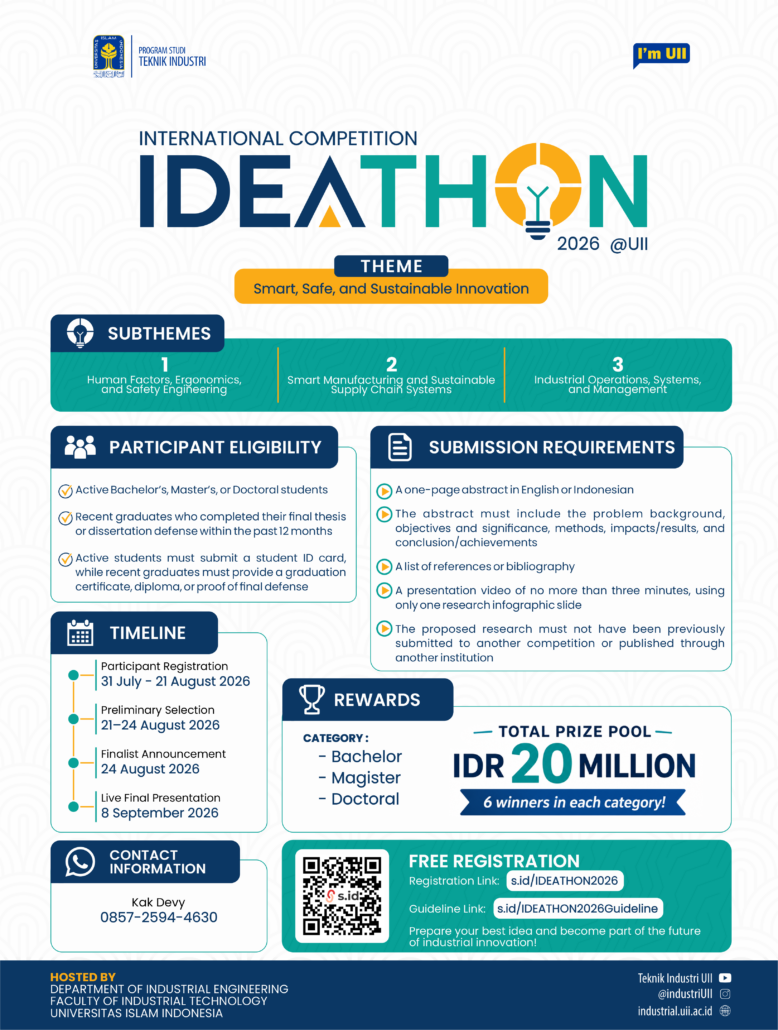
International Competition: IDEATHON 2026 @UII

The Department of Industrial Engineering, Faculty of Industrial Technology, Universitas Islam Indonesia (UI), proudly presents International Competition: IDEATHON 2026 @UII. This international competition provides a platform for undergraduate, master’s, and doctoral students, as well as recent graduates, to showcase their ideas and research in the field of Industrial Engineering on an international stage.

Within the theme “Smart, Safe, and Sustainable Innovation,” IDEATHON 2026 invites participants to develop innovative ideas that address real-world challenges in industry. Participants can explore their research through three subthemes: Human Factors, Ergonomics, and Safety Engineering; Smart Manufacturing and Sustainable Supply Chain Systems; and Industrial Operations, Systems, and Management.

The competition is open to Bachelor’s, Master’s, and Doctoral students, as well as recent graduates who completed their thesis or dissertation defense within the past 12 months.

Poster IDEATHON 2026 @UII

3 MINUTES TO MAKE AN IMPACT!

What makes IDEATHON 2026 unique is its concise and engaging presentation format. Participants are challenged to present their research through one research infographic slide and a maximum 3 minute presentation video. Within those three minutes, participants must communicate their research problem, objectives, methodology, findings, and impact in a way that is clear, concise, and compelling.

Beyond the opportunity to bring your research to a wider audience, IDEATHON 2026 also offers a total prize pool of IDR 20 MILLION across the Bachelor’s, Master’s, and Doctoral categories. Even better, registration is completely FREE!

READY TO SHOW YOUR RESEARCH?

If you have innovative research or ideas in Industrial Engineering, this is your chance to take your work to the international stage!

Registration: 31 July – 21 August 2026
Stage 1 Selection: 21 – 24 August 2026
Shortlisted Announcement: 24 August 2026

Final Presentation: 8 September 2026


Don’t miss this opportunity! Mark your calendar and get ready to join! 

Registration: s.id/IDEATHON2026 (FREE REGISTRATION!)
Guideline: s.id/IDEATHON2026Guideline
Contact Person: 0857-2594-4630 (Kak Devy)

Your research deserves to be seen. Your idea deserves to make an impact.
Bring your research to the international stage with IDEATHON 2026!


Syawarani Gayatri

10 Mahasiswa dan 2 Dosen Teknik Industri UII mengikuti kegiatan SAP ACC APAC 2026

The SAP ERP Laboratory Assistants from the Department of Industrial Engineering, Faculty of Industrial Technology, Universitas Islam Indonesia (UII), had the opportunity to participate in the SAP Academic Community Conference APAC 2026: “SAP Students Engagement Event with Partner,” held at the BINUS Alam Sutera Campus on Friday, (17/7). The event was attended by 10 Industrial Engineering students and two lecturers from UII, namely Dr. Ir. Yuli Agusti Rochman, S.T., M.Eng., IPU, and Ir. Bambang Suratno, S.T., M.T., Ph.D., IPM. In addition to attending the conference, the lecturers also participated in a series of SAP training sessions that had been held since Monday, (13/7).

This opportunity was made possible through the Department of Industrial Engineering UII’s membership in the SAP University Alliances program. Through this partnership, students have access to various academic and professional development activities organized by SAP and its industry partners. One of these opportunities was SAP ACC APAC 2026, which brought together students, academics, industry professionals, and business partners to explore the latest developments in SAP technology and gain insights into career opportunities within the SAP ecosystem.

Hands-on Practice SAP S/4HANA Cloud

Sesi Hands-On S/4HANA Cloud (S4C) Sandbox

Throughout the event, participants took part in a series of activities designed to provide both practical experience and insights into how SAP is applied in the industry. One of the highlights was the hands-on practice session, which allowed participants to explore Business Builders, SAP Learning Hub Student Edition, and the S/4HANA Cloud (S4C) Sandbox through SAP’s training access.

For UII Industrial Engineering students, the session provided an opportunity to build upon the practical SAP experience they had already gained on campus. Through the Enterprise Resource Planning (ERP) course supported by the SAP ERP Laboratory UII, students have previously gained hands-on experience working with SAP modules. The conference therefore offered an opportunity to take that experience further by exploring SAP platforms and features in a more extensive and direct setting.

SAP Partner Panel Sessions dan Partner Booth & Networking 

Sesi Pengenalan Dari Senior Solution Advisor at SAP Asia Pasific

Beyond hands-on practice, participants also gained a closer look at SAP implementation and career opportunities in the professional world through the Partner Panel Sessions, featuring representatives from SAP partner companies. The event continued with Partner Booths & Networking, giving students the opportunity to engage directly with industry partners, learn more about the SAP ecosystem, and gain insights into potential career paths in the field of SAP.

A Valuable Opportunity for UII Industrial Engineering Students 

Mahasiswa Teknik Industri Menyampaikan Kesan dan Pesan Mengikuti Kegiatan

The experiences gained throughout the event left a meaningful impression on the SAP ERP Laboratory Assistants from UII. One of the participants, Siti Ramadhani, expressed her gratitude for the opportunity

“I feel very grateful that Industrial Engineering UII is part of SAP University Alliances, allowing us to have opportunities like this. Through this event, we were able to explore SAP further and gain access to exclusive training resources.”

Sharing a similar experience, another participant, Rafif Fadilah, highlighted the valuable insights he gained and expressed his hopes for future opportunities:

“The event was really exciting because we gained so many new insights, especially about career opportunities and the development of SAP in the industry. I hope that students and the laboratory will have more opportunities to participate in events like this in the future, so we can continue gaining valuable knowledge and experience.”

The experience at SAP ACC APAC 2026 marks another step for UII Industrial Engineering students in strengthening their SAP competencies while gaining a deeper understanding of how SAP is applied in the industry. More importantly, opportunities like this provide valuable exposure that can help prepare future Industrial Engineering graduates to contribute effectively to an increasingly technology driven industrial landscape.

Syawarani Gayatri

Semarang, June 26, 2026 – The Industrial Engineering Study Program at Universitas Islam Indonesia (UII) organized an industrial visit to PT Marifood, located in the Candi Industrial Estate, Semarang, as part of its commitment to providing students with practical industrial experience. The annual program involved Industrial Engineering students from the Class of 2024 and was designed to strengthen their understanding of concepts taught in the Quality Control and Quality Assurance course.

Accompanied by faculty members, the students explored how manufacturing theories are applied in real industrial settings. The UII industrial visit provided valuable exposure to production systems, quality assurance practices, and modern manufacturing operations, allowing students to connect classroom learning with industry practices.

UII Industrial Engineering Students Explore Manufacturing Processes at PT Marifood

The UII Industrial Visit began with a guided factory tour, where students observed the production process and learned how automated packaging systems improve efficiency and product quality. They gained firsthand knowledge of manufacturing workflows, from raw material processing to finished product packaging, while observing how quality standards are maintained throughout the production line.

Following the factory tour, the participants returned to the main hall and were invited to sample a variety of PT Marifood’s food and beverage products. Several students also had the exclusive opportunity to participate in a tasting session for products that have not yet been released to the public, making the experience even more memorable.

“This has been a completely new and valuable experience throughout my university life. I hope activities like this will continue to be organized in the future,” said Sekar.

The educational visit concluded with a token of appreciation presented by PT Marifood’s management in the form of a framed group photograph, commemorating the collaboration between the company and Universitas Islam Indonesia.

Strengthening Student Bonds at Saloka Theme Park

Mahasiswa Teknik Industri di Saloka Theme Park

After completing the academic agenda at PT Marifood, the students continued their journey to Saloka Theme Park in Semarang. The recreational visit provided an opportunity to relax after a full day of industrial learning while strengthening friendships and teamwork among classmates.

As the largest theme park in Central Java, Saloka offered an enjoyable environment where students could create lasting memories before returning to Yogyakarta. The combination of educational and recreational activities highlighted the importance of balancing academic development with student engagement.

“It was so much fun and the perfect opportunity to relax while strengthening our friendship with our classmates. I hope activities like this will continue because they provide unforgettable experiences,” said Salsa.

The industrial visit to PT Marifood and Saloka Theme Park successfully provided Industrial Engineering students from Universitas Islam Indonesia with valuable insights into modern manufacturing practices while fostering stronger relationships among their peers. Through direct exposure to industrial operations and quality management systems, students gained practical knowledge that complements their academic studies and prepares them for future careers in the manufacturing industry.


Kaila Bilbina M.S

Ahmad Arro’uf Sulfuadi, a student in the Industrial Engineering Program at the Faculty of Industrial Technology (FTI), Universitas Islam Indonesia (UII), won 3rd place at the International Student Symposium 2025. This competition will be organized by the ASEAN School of Business Network (ASBN) in August 2025. Arro’uf competed in the essay category under the sub-theme “Green Economy and AI: Opportunities and Challenges.” Arro’uf presented an idea regarding the integration of AI in the management of renewable energy on an ASEAN regional scale. He adopted a benchmarking approach based on the ASEAN Power Grid initiative proposed by the ASEAN Center for Energy (ACE). He also outlined how the integration of AI can more efficiently bridge cross-border boundaries. This achievement demonstrates that UII Industrial Engineering students are capable of contributing to discussions on global issues at the international level.

From In-Depth Research to the International Finals

The competition consists of two stages: the preliminary round and the finals. Participants come from various countries at the international level. Since the competition is individual, Arro’uf handled the entire process on his own, proceeding at a slow and measured pace. Throughout the process, he positioned himself as a policy consultant. He presented real-world data on the potential for renewable energy in each of the pioneering ASEAN nations. He also designed an automated energy exchange system powered by AI authorized by the APC.

Arro’uf delved into the topic through a literature review on the application of AI in macro-scale energy management. He also watched various podcasts and videos on how AI is used in corporate-level energy management. From there, he began to consider whether this technology could be developed for use on a broader scale.

Arro’uf’s biggest challenge in this competition was presenting an innovative yet rational idea. He had to balance the potential for AI implementation in energy exchange with the reality of policy resistance and varying levels of openness in each country. Through his persistence, Arro’uf became a finalist among 10 international participants and secured 3rd place.

Essays as a Space for Sharing and Exchanging Ideas

In the final round, Arro’uf had the opportunity to witness interesting ideas from participants from other countries. A Vietnamese participant discussed Mekong River economic routes, while a Thai participant explored electric trains as sustainable transport. This experience broadened his perspective, showing him that this issue can be approached from diverse viewpoints in each country.

Arro’uf views this achievement as a highly valuable experience, especially since he had initially doubted his own idea in the early stages. He encourages other students not to hesitate to express their ideas through essays. Arro’uf sees the essay as a flexible medium because it allows anyone to explore ideas as broadly as possible, provided they are supported by real and rational data.

“So, in my opinion, an essay is a great platform to voice your ideas!” said Arro’uf.

Arro’uf also emphasized that ideas that seem too unrealistic to implement might actually be needed by those who already have the capacity to make them happen. Arro’uf proves that presenting big ideas can help Indonesian students make an impact on the international stage.

Nisrina Nur Masrefa

Rajab Bullah Anggara Nasution, Akbar Muntaqo, Nugraheni Novita Hutami, and Fathia Aqila Zatadini are students in the Industrial Engineering Program, Faculty of Industrial Technology (FTI), Universitas Islam Indonesia (UII). They successfully won a Bronze Medal at INDES 2025. The International Invention, Innovation and Design Competition (INDES) 2025 is a competition for innovation and design that brings together various creative ideas in the form of innovative products or works. The event took place on June 26, 2025, and focused on aspects of innovation, invention, and product design.

In this competition, the team developed the ECOBARA STOVE, an eco-friendly incinerator innovation designed to support more efficient waste management. This project serves as a waste management solution by designing a more environmentally friendly and beneficial waste incinerator. This achievement demonstrates that UII Industrial Engineering students are capable of providing solutions to environmental problems through innovation.

From Team Discussions to Final Presentations

The competition began with the development of ideas and product concepts together with all team members. Preparations included researching incinerators and waste management. In addition, the team developed the ECOBARA STOVE concept and created presentation materials and supporting media. During this phase, tasks were assigned based on each team member’s capabilities and skills.

The biggest challenges the team went through were managing their time and aligning ideas among members. They also had to explain the incinerator concept in a way that was easy for the judges to understand. The team overcame these challenges through effective communication, clear task allocation, and joint evaluations before the event day. With perseverance and teamwork, the project was successfully presented. The project was evaluated based on innovation, creativity, benefits, and thematic relevance, ultimately leading the team to win a Bronze Medal.

A Valuable Experience Behind the Bronze Medal

For Rajab, one of the team members, INDES 2025 was a valuable experience in developing innovative ideas, building teamwork, and building confidence when presenting the project. The process they went through together underscored the importance of listening to each other’s opinions and resolving challenges collectively. The team’s unity was the key to their success in winning the Bronze Medal.

“Don’t be afraid to try entering competitions. From competitions like this, we can gain experience, broaden our horizons, practice teamwork, and boost our self-confidence. The key is to dare to start, be willing to learn, and stay motivated throughout the process,” said Rajab.

Rajab also emphasized that a simple idea can become a useful project if developed with dedication. The team’s courage proves that innovations born from a concern for the environment can compete on the international stage.

Nisrina Nur Masrefa