UII Industrial Engineering Practitioner Lecture: Project Quality Management
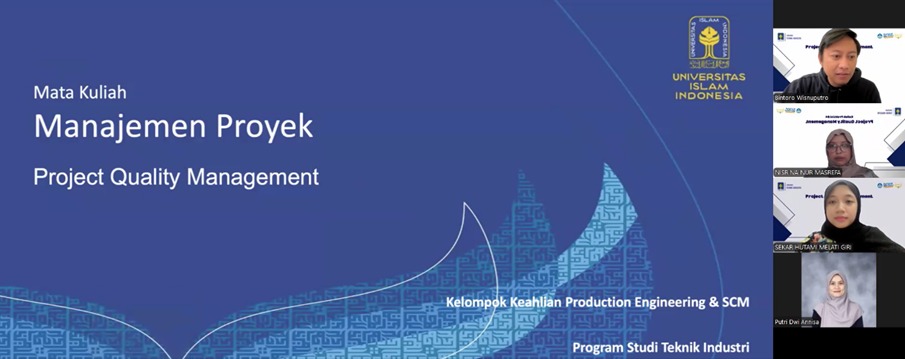
A practitioner lecture on Project Management with the theme “Project Quality Management” organized by the Industrial Engineering Study Program, Faculty of Industrial Technology (FTI), Islamic University of Indonesia (UII) was held online on Saturday (06/12). The event aimed to provide students and participants with insights into best practices for effectively and professionally managing project quality. By featuring practitioners who are experienced academics, this practitioner lecture is expected to provide a deeper understanding of project management theory and its implementation in the industrial sector.
Nisrina Nur Masrefa, as the Master of Ceremony, opened the event at exactly 1:00 PM WIB, followed by a group photo session. The event then continued with moderator Sekar Hutami Melati Giri introducing the speaker for this practitioner lecture, Bintoro Wisnuputro. He has been a Senior Project Management Office (PMO) at Pertamina since 2020 and brings extensive knowledge of Project Quality Management.
Why Are High Quality Products Not Necessarily High Grade?
Bintoro began his presentation by explaining a concept often misunderstood in project management about the difference between quality and grade. He explained that these two terms have different meanings and cannot be equated. Both are related to the standards of a product or service. Quality refers to the fulfillment of customer expectations or conformity to specified requirements. Grade refers to the level or classification of a product.
“Something with a low grade is not necessarily of poor quality. Conversely, something of poor quality is not necessarily of a low grade. It could be of a high grade,” he explained.
Bintoro continued by providing an illustration using the example of sachet coffee and V60 coffee in a cafe. Sachet coffee with a low grade can be high quality due to its consistent taste. Meanwhile, V60 coffee with premium beans may be low quality if the serving process does not follow standard procedures. This example shows students that project quality is measured by meeting customer expectations, not by price or grade.
Bintoro emphasized that overlooked small details often cause quality failures. The NASA tragedy proved this, when the team failed to test the O-ring at low temperatures, leading to an explosion. Furthermore, Bintoro discussed various quality management theories and philosophies applied at Pertamina and Japanese manufacturing companies. He emphasized the importance of prevention, quality cost analysis, and organizational involvement in continuous improvement.
Q&A Session

During the Q&A session, participants actively asked various questions related to the implementation in industrial practice. The questions asked about minor punch lists and conditions without punch lists after the pre-mechanical completion stage. They also asked what the process would be if major problems were found, related to quality issues in fields with long-term planning. Additional questions focused on the change request approval process in large-scale projects.
Bintoro explained that without a punch list, the project enters the finishing stage immediately. A minor punch list is corrected, while a major one requires recalculation and reconstruction. He emphasized that quality management is an end-to-end process from planning to execution, and failures in the field can result from miscalculations during planning. Regarding change requests, old projects facing new conditions are considered new or upgraded projects, while change requests apply only to modifications in ongoing projects with authorized approval.
Finally, practical lecture ended with Bintoro’s reflective insights on project management, which has a wide range of applications in various fields, and the importance of building soft skills from an early age. With the enthusiasm shown by the participants during the practical lecture, it is hoped that it will inspire students to apply quality management and prepare themselves to contribute industrial projects.
Nisrina Nur Masrefa
 IP IE UII
  HARIAN JOGJA